Archive for the ‘africa’ Category
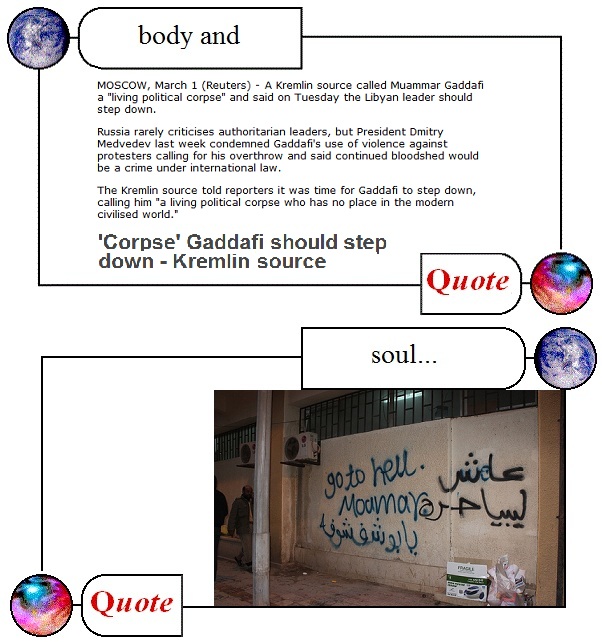
When Dictators Go Mad – Gaddafi Sentences Libya to Death
Tuesday, February 22nd, 2011
Twitter is absolutely amazing on reporting events on Libya the last few days. What they lose in passing on rumors the make up for by being hours or days ahead of MSM and USG reaction.
Col. Gaddafi, who looks these days like a cross between a has-been rock star in Celebrity Rehab and Ethel Merman in her dotage, is desperately trying to cling to power and has unleashed artillery, naval bombardment, warplanes, helicopter gunships and African mercs on his own people. No word if the honorable member of the UN Human Rights Panel has employed poison gas yet, but the Libyans appear to be holding their own in fierce fighting in Libya’s largest cities.
The USG response has been muted on Libya. This sober restraint may reflect the vulnerability of American oil industry workers trapped in the fighting as well as the discomfort of anticipation of the details of recent deals between Western corporations and former government officials and the Libyan regime coming to light if Gaddafi falls. Or alternatively, Gaddafi tearing lucrative agreements up if he remains in power.
Guest Post: Mexico, Africa, Zarqawi?
Thursday, October 28th, 2010
Charles Cameron is the regular guest-blogger at Zenpundit, and has also posted at Small Wars Journal, All Things Counterterrorism, for the Chicago Boyz Afghanistan 2050 roundtable and elsewhere. Charles read Theology at Christ Church, Oxford, under AE Harvey, and was at one time a Principal Researcher with Boston University’s Center for Millennial Studies and the Senior Analyst with the Arlington Institute:
Zen here – I think Charles has hit upon a primal psychological mechanism that comes into full flower as societies break down and war begins to shade into warlordism. We have seen this repeatedly in history from Tamerlane’s mounds of skulls to Khmer Rouge killing fields. Mad Barons, Dogmeat Generals, Friekorps kapteins and butchers long since forgotten by history- there’s a gravitational pull toward atavistic, symbolic, destruction as social norms erode under the corrosive effects of escalating violence.
Mexico, Africa, Zarqawi?
by Charles Cameron
I’ve been struck by a couple of passages I’ve run across in my reading recently that remind me of what I can only call “brutality with religious overtones”.
1. Mexico
There have been a fair number of articles about the various Mexican cartels, but the excerpt from Ed Vulliamy’s book, Amexica: War Along the Borderline that’s now online at Vanity Fair is the one that caught my eye yesterday.
Here’s Vulliamy’s account of a conversation with Dr. Hiram Muñoz of Tijuana:
He explained his work to me during the first of several visits I have made to his mortuary. “Each different mutilation leaves a message,” he said. “The mutilations have become a kind of folk tradition. If the tongue is cut out, it means the person talked too much—a snitch, or chupro. A man who has informed on the clan has his finger cut off and maybe put in his mouth.” This makes sense: a traitor to a narco-cartel is known as a dedo — a finger. “If you are castrated,” Muñoz continued, “you may have slept with or looked at the woman of another man in the business. Severed arms could mean that you stole from your consignment, severed legs that you tried to walk away from the cartel.”<¶>Earlier this year, 36-year-old Hugo Hernandez was abducted in Sonora; his body turned up a week later in Los Mochis, Sinaloa, but not in a single piece. His torso was in one location, his severed arms and legs (boxed) in another. The face had been cut off. It was found near city hall, sewn to a soccer ball.
That’s the brutality — I haven’t see the book itself yet, but I gather it also gets into the narco-corrida music and the “quasi-Catholic cult of Santíssima Muerte” — which brings me to the second part of my interest – the religious aspect.
As Vulliamy mentions, there’s the cult of Holy Death, to be sure, a sort of shadow or inverse of the Blessed Virgin — a Dark Mother for dark times, or perhaps a revival of the ancient Mictlancihuatl, lady of the Dead? — with her own liturgy, too:
Almighty God: in the name of the Father and of the Son and of the Holy Spirit, we ask for your permission to summon Saint Death. Welcome, White Sister: we find ourselves gathered here at this altar of the Romero Romero family and of each one of us, to offer you a Mass that we hope you will like…
Which brings us to the Robin-Hood-like bandit and folk-saint, Jesus Malverde, to whom prayers such as the following [FBI .pdf, see p. 20] are offered:
Lord Malverde, give your voluntary help to my people in the name of God. Defend me from justice and the jails of those powerful ones. Listen to my prayer and fill my heart with happiness. For you shall make me fortunate.
There are even miracles attributed to him:
Oh Malverde! The Vatican did not believe you to be holy and would not canonize you, but when they brought the Caterpillars to tear down your hood, you broke one machine and nobody could move you away, you broke another, leaving those who disrespect you speechless — and when the third one broke, they said, “Let Malverde’s chapel alone.”
Right beside the syncretistic quasi-Catholicism, there’s also a Protestant angle: La Familia is the group that, in Vulliamy’s words, “made its ‘coming out’ known in a famous episode: bowling five severed heads across the floor of a discotheque.” Time magazine reported on what it termed Mexico’s Evangelical Narcos:
Federal agents seized one copy of La Familia’s Bible in a raid last year. Quoted in local newspapers, the scripture paints an ideology that mixes Evangelical-style self-help with insurgent peasant slogans reminiscent of the Mexican Revolution. “I ask God for strength and he gives me challenges that make me strong; I ask him for wisdom and he gives me problems to resolve; I ask him for prosperity and he gives me brain and muscles to work,” Moreno writes, using terms that could be found in many Christian sermons preached from Mississippi to Brazil. But on the next page, there’s a switch to phrases strikingly similar to those coined by revolutionary Emiliano Zapata. “It is better to be a master of one peso than a slave of two; it is better to die fighting head on than on your knees and humiliated; it is better to be a living dog than a dead lion.”
As I commented on Zenpundit a while back,
What’s troubling here is that there is only one undoubtedly “evangelical” phrase in all those that Time quotes, and it is one of then ones said to resemble the aphorisms of Emilio Zapata. “It is better to be a living dog than a dead lion” is a pretty direct borrowing from Ecclesiastes 9.4 in the King James Version: “To him that is joined to all the living, there is hope: for a living dog is better than a dead lion.”
But that’s not actually all. I didn’t mention it at the time, but “I ask God for strength and he gives me challenges that make me strong; I ask him for wisdom and he gives me problems to resolve; I ask him for prosperity and he gives me brain and muscles to work” is almost word-for-word the same as a poem attributed to Islam — or Judaism for that matter. Indeed, it can be hard to tell who is borrowing from whom – but one final source for the La Familia bible is known – it’s the book Wild at Heart by John Eldredge, the pastor of a ministry in Colorado Springs, who must have been surprised at the uses to which his writings were being put.
In any case, as I said on Zenpundit: These people have a theology, and we should be studying it.
2. Africa
My thoughts turned to Africa when I read another paragraph recently, this one from Johann Hari’s review, The Valley of Taboos, of V.S. Naipaul’s new book, The Masque of Africa: Glimpses of African Belief:
I have stood in a blood-splattered house in Tanzania where an old woman had just been beaten to death for being a “witch” who cast spells on her neighbors. I have stood in battlefields in the Congo where the troops insist with absolute certainty they cannot be killed because they have carried out a magical spell that guarantees, if they are shot, they will turn briefly into a tree, then charge on unharmed. I have been cursed in Ethiopia by a witch-doctor with “impotence, obesity, and then leprosy” for asking insistently why he charged so much to “cure” his patients. (I’m still waiting for the leprosy.) Where do these beliefs come from? What do so many Africans get out of them? Can they be changed? These are questions that are asked in Africa all the time, but we are deaf to the conversation.
That sent me in search of some early military anthropology related to guerrilla warfare I’d come across in earlier readings.
James R Price and Paul Jureidini’s 1964 Witchcraft, Sorcery, Magic, and Other Psychological Phenomena and their Implications on Military and Paramilitary Operations in the Congo, and Roger D Hughes’s 1984 Emergency in Kenya: Kikuyu and the Mau Mau Insurrection are both of considerable interest here — but it is LSB Leakey, the world-class British archaeologist initiated as a boy into the Kikuyu ways, who has written the most provocative summary of the relationship between political and religious violence and ritual that I’m interested in tracking.
I’m quoting here from the chapter on “The Mau Mau Religion” in Maj. Hughes paper:
Leakey’s original hypothesis in Mau Mau and the Kikuyu: “Mau Mau was nothing more than a new expression of the old KCA … a political body that was banned … because it had become wholly subversive.” Furthermore, “Mau Mau was synomomous with the new body called the in school, Kenya African Union…” However, Leakey admits to a reversal of his original hypothesis in Defeating Mau Mau, and goes on to say, “Mau Mau, while to some extent synonymous with these political organizations, was in fact a religion and owed its success to this fact more than to anything else at all.”<¶>He then proceeds to attribute the origin of Mau Mau to an “ideology transfer,” wherein the religious beliefs of the Kikuyu transitioned from their ancient tribal religion to Euro-Christianity to Mau Mau. The first transition took place artificially, as the missionaries stripped away the traditional beliefs and supplanted them with “20th Century Europe’s concept of Christianity.” The second transition was more natural and evolutionary than the first. A reactionary hybrid of the old and the new developed, because the supplanted concepts would not hold up in their society. There were too many contradictions between the old and the new, mainly due to the 20th Century European “add-ons.”
Most of us have a pretty fixed view of what religion is, should be, or isn’t. Some of my readers no doubt hold to a evangelical Christian position, some are Catholic, some perhaps Buddhist, agnostic or atheist, and some perhaps Muslim. Each of us tends to take our own view of a particular religion as normative, but the reality is that the history of each of the great world religions contains sanctions for both peace-making and warfare — and human nature itself encompasses a range of behaviors that run from the kind of atavistic violence described above to the forgiving and compassionate impulse behind the Beatitudes…
And while economic pressures and political frustrations may be enough to power great struggles, when religious rituals, beliefs and feelings are added into the mix, it can quickly become even more lethal.
3. And Zarqawi?
All of which leaves me wondering how close the parallels are between the Mau Mau in LSB Leakey’s account, La Familia and the other Mexican cartels — and the brutalities of jihadists such as Abu Musab al-Zarqawi.
The Need for Old Hands: Mackinlay on Old COIN
Friday, March 19th, 2010Currently reading The Insurgent Archipelago 
….The ratio of coloniser to colonised – and of the tiny British contingent to the vast numbers of the native population –
suggested that a degree of consent to their presence was already inherent. The officials in each colony were competitively selected from an educated and ambitious British upper class, in many cases they were talented and intrepid men, used to living and campaigning in the field, with an intelligent grasp of their territory, its people, languages and culture. They survived and succeeded on their wits, natural authority and knowledge. When the colonised population rose up in insurrection and military force was rushed to the scene, it was subordinated to these same British administrators who became responsible for the direction of the campaign. All the problems of devising a political strategy, ensuring the legitimacy of the military actions and restoring the structures of governance were taken care of by a familiar hub of individuals. It was a continuously reconvening club in which personal relationships tended to override the ambiguities of their civil-military partnership.
Admittedly, there’s a shiny high gloss of romantic nostalgia for the Raj here, polishing the historical reality. The British Empire also saw examples of arrogance or cruelty by British colonial officials that helped provoke uprisings like the Sepoy Mutiny. Or, high-level imperial administrators could zealously pursue local colonial expansion, as Viscount Milner did in starting the needless Second Anglo-Boer War, which partially involved putting down a grueling Trekboer insurgency, that ultimately weakened the Empire at the strategic level.
Those calamities, as expensive and bloody as they were, were exceptions. Mackinlay is correct in assessing the value of Britain’s colonial administrative class, whose deliberate cultivation of “Old Hands” permitted a sixth of the earth’s surface to be ruled relatively cheaply from Whitehall. Lord Milner, for all his faults, could at least speak to President Kruger in his own language and understood the Boer states on which he was waging war, even if he disdained the Afrikaner settlers. It’s hard to imagine many American statesmen or senior generals (or sadly, CIA agents and diplomats) fluently debating foreign counterparts in Arabic, Pashto, Farsi or Chinese. British officialdom took the time – and had the time, professionally – to learn the languages, dialects and customs of the peoples with whom they allied or fought, conquered and ruled.
Not so in contemporary peacekeeping /crypto-COIN operations , according to Mackinlay:
By the 1990’s the colonial officials who had been the key element in every operation since Cardwell were now missing. Coalition forces were intervening in countries that were the antithesis of the former colonies, where the incoming military were regarded as occupiers and where there was no familiar structure of colonial officials and district officers to be seen. Moreover, the diplomats who belatedly attempted to fill this role, although no doubt intellectually brilliant, crucially lacked the derring-do, local credibility and natural authority of their colonial era predecessors. A few extra hands from the Foreign Office or the State Department could not compensate for the loss….
….Although at a local level the British counter-insurgent techniques proved to be successful, broader problems presented themselves as a result of an absence of strategy and a failure of campaign design, particularly in the civil-military structures. It was simply not a realistic option to fill the void left by the departure of a national government – with all its natural expertise and authority – with a band-aid package of contracted officials and flat-pack embassies.
New Hands cannot act or think like Old Hands. They lack not only the in-country experience and linguistic skills but the entire worldview and personal career interests of the American elite mitigate against it. “Punching tickets” is incompatible with becoming an Old Hand and aspiring to be an Old Hand is incompatible with continued employment at most foreign policy agencies of the USG.
American Foreign Service Officers, CIA personnel and flag officers never had the same historical frame of reference as their Imperial British cousins, but the culture of the Eastern Establishment approximated a high church Yankee Republican version that provided an elan, a worldly knowledge and moral certitude until the Establishment’s will to power and self-confidence was broken by the Vietnam War. Subsequent generations of American elite have been indoctrinated in our best institutions to instinctively distrust the marriage of cultural knowledge and political skills to the service of advancing national interest as “Orientalism“.
I am not an admirer of Edward Said but the man was no fool. He understood the strategic importance for his radical political faction of populalrizing the de-legitimization the learning of other cultures and languages as immoral for any reason except partisanship in their favor against the interests of the predatory West. This is why something as esoteric and parsimoniously funded as “Human Terrain Teams” meet with volcanic rage from academic leftists, especially in the fields of anthropology and political science. This is the sort of censorious mindset that would have made the works of Herodotus, Alexis de Tocqueville, the Marquis de Custine, Richard Francis Burton, T.E. Lawrence, Ruth Benedict, Rene Grousset, Raphael Patai and Bernard Lewis, to name just a few, impossible.
Recovering our capacity to act effectively and see with clarity requires the training of a new generation of Old Hands to interpret and act as policy stewards and agents in regions of the world in which most Americans are unfamiliar and likely to remain so. Current academic PC ideological fetishes reigning at our Ivy League universities artificially shrink our potential talent pool. Alternative educational pathways through military service academies, think tanks, professional and Cross-cultural associations and better USG training programs need to be developed to route around the university gateway that is largely in control of keepers hostile or indifferent to American foreign policy objectives. By the same token, USG agency and military personnel and security clearance policies need a systemic overhaul to better take advantage of those already in service who find their career paths blocked or frustrated.
We waste talent on a massive scale.
Some Important AFRICOMmentary
Wednesday, March 5th, 2008My schedule recently did not permit much in the way of my normal, extensive, blogsurfing that is the genesis of my regularly scheduled Recommended Reading posts. I would however, like to highlight Matt Armstrong’s recent, in depth, post on AFRICOM. Much like 7-Up, if the vision pans out, AFRICOM is to be “The Un-Combatant” Command. Sys Admin from the inception, interagency “jointness” in conception. But will that actually happen in the real world?
AFRICOM: DOA or in need of Better Marketing? No and Yes.
By Matt Armstrong
Like Mark Twain’s “death” in 1897 (he died in 1910), reports of AFRICOM’s demise may be exaggerated. Concerns that AFRICOM hasn’t been thought out or is unnecessary aren’t supported by the actions and statements of those charged with building this entity. However, based on the poor marketing of AFRICOM, these concerns are not surprising.
I attended USC’s AFRICOM conference earlier this month and between panel discussions and offline conversations, I came away with a new appreciation (and hope) for the newest, and very different, command.
This is not like the other Combatant Commands (one DOD representative said they dropped “Combatant” from the title, but depending on where you look, all commands have that word or none of the commands include that adjective). Also unlike other commands, this is “focused on prevention and not containment or fighting wars.” This is, as one speaker continued, is a “risk-laden experiment” that is like an Ironman with multidisciplinary requirements and always different demands (note: thank you for not saying it’s a marathon… once you’ve done one marathon, they’re easy, you can “fake” a marathon… Ironman triathlons are always unpredictable, I know, I’ve done five.). The goal, he continued, was to “keep combat troops off the continent for 50 years” because the consensus was, once troops landed on Africa, it would be extremely difficult to take them off.
General William “Kip” Ward realizes that only once in several generations is there the opportunity to stand up a new command. General Ward has worked hard to create something new and unique that addresses modern security dilemmas. Modern communications and the vastness of Africa make a singular location for AFRICOM impractical. For example, the Democratic Republic of the Congo alone is nearly 1/4 the size of the U.S. and has 130 million people alone. Across the continent political boundaries on the map mask tremendous language and cultural variations.
The goal, as it was laid out in the conference, is to divide AFRICOM into four tiers because it is “easy to overwhelm our African partners in [both] enthusiasm [and] size.”
Read the rest here.


