Echevarria – War in the Post-Clausewitz Era?
Thursday, April 29th, 2010
From the Strategy Conference…….
From the Strategy Conference…….
I continue to be impressed with Dr. John Mackinlay‘s The Insurgent Archipelago 


This is going to be an influential text.
In Mackinlay’s view, America and the West have failed to adequately understand what and whom they are fighting in the War on Terror. The phenomenon that has eluded them is that alongside older, Maoist iterations of guerrilla warfare, the cutting edge of insurgency has evolved up into a decentralized, networked, partly virtual, Post-Maoism. General staffs, intelligence services, national security officials and diplomats remained hypnotized by the Maoist model that was so frequently aped in the 60’s and 70’s by secular leftists and Third World Marxists in Vietnam, Algeria and subsaharan Africa.
Some excerpts, followed by my analysis, which you are free to disagree with or just put in your own two cents about in the comments section:
Mackinlay writes [p. 164]:
….NATO governments and a majority of their security staff did not recognize post-Maoism as a form of insurgency either. Although they lived in a post-industrial era and directly experienced its social consequences, they dealt with post-9/11 insurgent phenomenon from a Maoist perspective; they neither saw it nor engaged it as a global movement that involved a greater array of dispersed supporters. They also failed to recognize it as an insurgency.
Very true. Even though if the organizational behavior of al Qaida and its affiliated movements had taken place within one nation-state, Cold War era graybeard officials and international law NGO activists of 2001-2004 vintage would have called them a guerilla movement; that al Qaida’s activities took place across many international borders seriously confounded them in an intellectual sense. Obviously, they must be common criminals, no different than junkies who stick-up a 7-11, to be properly mirandized! Call the FBI and have OJ’s dream team ready when we make an arrest! Or Osama is a state-sponsored terrorists of Saddam! No, wait, of Iran!
And so it went, and still goes on to this day as the USG contorts itself into a legal pretzel in order to never have proper war crimes trials or execute convicted war criminals. Or even admit they are “Islamists” motivated by a reified ideology (Mackinlay’s term “Post-Maoist” may soon come in to vogue at the NSC).
America is like the Gulliver of COIN, bound fast by the cords of politically correct nonsense.
….Because few academics had explained insurgency as a multidisciplinary, as opposed to a narrowly military, process they failed to see how their own populations were vulnerable to insurgent movements, and that when it happened to them it would not look like its classic Maoist antecedent. Countering insurgency required a counterintuitive effort and making this intellectual leap was problematic when military planners had such an idee fixe of insurgency as eternally Maoist form.
I interpret this paragraph as Mackinlay blending the Euro-Anglo-American state of affairs, but it does not apply equally to all, in my view.
Humanities and social science academics are simply not as good at or as intellectually comfortable with true multidisciplinary thinking as are their counterparts in the hard sciences. Nor are the social science faculty particularly friendly, in most universities, toward the US national security and intelligence communities or the Pentagon (though I suspect the situation in 2010 is better than in 2000 or 1990). Nor are American universities oversupplied with military historians or scholars of strategic studies.
Academia, however is not at fault as much as Mackinlay indicates. Even if we had Clausewitz collaborating with Ibn Khaldun and Marshall Mcluhan to write our white papers, the USG interagency process is fundamentally broken and could not execute their recommendations. State is grossly underfunded, institutionally disinclined to turn out FSO’s in the mold of Errol Flynn and is in need of a systemic overhaul. USIA and USAID need to be reborn as heavyweight players. The CIA has problems almost as severe as does State and does not play well with others, including the DNI. There is no “whole of government” approach present that could approximate an “operational jointness”, so presidents increasingly rely on the military as the hammer for all nails ( the military may not do the right thing but at least it does something, as the saying goes).
Mackinlay writes [p. 164-165]
….By 2008 the most up-to-date doctrine was still stuck in expeditionary form, in other words focused on a campaign epicentre that lay in a particular overseas territory and its traditional, or at best modernising, society. The following characteristics that distinguished post-Maoism had not been engaged:
- The involvement of multiple populations which challenged the concept of a center of gravity
- Mass communications and connectivity
- The migration factor
- The virtual factor
- The centrality of propaganda of the deed in the insurgent’s concept of operations
- The bottom-up direction of activist energy
- Absence of plausible end-state objectives in the insurgent’s manifesto
Mackinlay gets much right here but some things wrong – and what is incorrect is arguably quite important – but as an indictment of the failure of the West to adequately address globalized insurgency, it is spot on in many respects.
First, in regard to Mackinlay’s attack on Clausewitzian theory, I am not persuaded that a “center of gravity” for our enemies does not exist or apply so much as its form is not a particularly convenient one (i.e. -easily targetable) or politically comfortable for our elites to acknowledge.
We could conceive of al Qaida’s CoG being Bin Laden’s inner circle hiding somewhere in Pakistan – probably Rawalpindi – that we do not yet dare to strike. Or we could say that the CoG is al Qaida’s “plausible promise” that the “far enemy” of radical Islamism, the US, can be brought down, as was the USSR, by being bled to death by drawing America into endless and expensive wars. Or that the CoG is al Qaida’s peculair, Qutbist-inspired, takfiri, revolutionary Islamist ideology. Our elites recoil from openly confronting any of those possible scenarios but that does not mean that a CoG is not present, only that we lack the will to attack their CoG head-on.
US COIN doctrine is expeditionary – essentially internal COIN for America ended with the Compromise of 1877 and the end of three centuries of “Indian Wars”. Political correctness, not doctrinal rigidity, precludes recognizing Islamist lone wolf terrorists like Maj. Hasan as anything other than mentally ill spree killers, no different from the school shooters at Columbine or Andrew Cunanan. The USG would not recognize an insurgency in the states as an insurgency even if it had flags, a government-in-exile, an air force and armored divisions. Even the capture of verified and admitted members of al Qaida inside the United States, who are covered by a properly authorized AUMF, causes an epidemic of pants-wetting among the elite, if we proceed to try them with military tribunals or commissions.
We do not have a political elite as a national leadership who are prepared to entertain the full strategic ramifications of the existence of a “globalized insurgency”. They do not ignore it completely – the COIN doctrine articulated best by David Kilcullen and John Nagl is to de-fang al Qaida as a strategic threat by isolating it from the “Accidental Guerrilla” groups whose Islamist concerns are parochial and national in character rather than global. So, al Qaida is seen by the American national security community as a de facto globalized insurgency with a reach that extends everywhere – except of course inside the United States. Unless we intercept foreign Islamist terrorists crossing the border or boarding a plane, any violent actions committed here resembling terrorism are purely a law enforcement issue and must be wholly unrelated to Islamist extremism.
It’s a bizarrely illogical strategic worldview – and I fear its’ ostrich-like mentality has already spread from War on Terror policy to matters related to the empirically demonstrable, but continuously downplayed, spillover effects of Mexico’s growing narco-insurgency, where high officials prohibit unvarnished “truth telling” from practitioners in the field from reaching the ears of key decision-makers. It’s no way to run a war – or a country – unless the intent is to lose the former by systematically crippling the ability to respond of the latter.
Mackinlay’s characteristics of “Post-Maoism” strike directly and the political and methodological nerve clusters of a Western elite whose power and status are invested in hierarchical, bureaucratic, institutional structures that are defended from urgent demands to reform, in part, by their ideology of political correctness.
Currently reading The Insurgent Archipelago
….The ratio of coloniser to colonised – and of the tiny British contingent to the vast numbers of the native population –
suggested that a degree of consent to their presence was already inherent. The officials in each colony were competitively selected from an educated and ambitious British upper class, in many cases they were talented and intrepid men, used to living and campaigning in the field, with an intelligent grasp of their territory, its people, languages and culture. They survived and succeeded on their wits, natural authority and knowledge. When the colonised population rose up in insurrection and military force was rushed to the scene, it was subordinated to these same British administrators who became responsible for the direction of the campaign. All the problems of devising a political strategy, ensuring the legitimacy of the military actions and restoring the structures of governance were taken care of by a familiar hub of individuals. It was a continuously reconvening club in which personal relationships tended to override the ambiguities of their civil-military partnership.
Admittedly, there’s a shiny high gloss of romantic nostalgia for the Raj here, polishing the historical reality. The British Empire also saw examples of arrogance or cruelty by British colonial officials that helped provoke uprisings like the Sepoy Mutiny. Or, high-level imperial administrators could zealously pursue local colonial expansion, as Viscount Milner did in starting the needless Second Anglo-Boer War, which partially involved putting down a grueling Trekboer insurgency, that ultimately weakened the Empire at the strategic level.
Those calamities, as expensive and bloody as they were, were exceptions. Mackinlay is correct in assessing the value of Britain’s colonial administrative class, whose deliberate cultivation of “Old Hands” permitted a sixth of the earth’s surface to be ruled relatively cheaply from Whitehall. Lord Milner, for all his faults, could at least speak to President Kruger in his own language and understood the Boer states on which he was waging war, even if he disdained the Afrikaner settlers. It’s hard to imagine many American statesmen or senior generals (or sadly, CIA agents and diplomats) fluently debating foreign counterparts in Arabic, Pashto, Farsi or Chinese. British officialdom took the time – and had the time, professionally – to learn the languages, dialects and customs of the peoples with whom they allied or fought, conquered and ruled.
Not so in contemporary peacekeeping /crypto-COIN operations , according to Mackinlay:
By the 1990’s the colonial officials who had been the key element in every operation since Cardwell were now missing. Coalition forces were intervening in countries that were the antithesis of the former colonies, where the incoming military were regarded as occupiers and where there was no familiar structure of colonial officials and district officers to be seen. Moreover, the diplomats who belatedly attempted to fill this role, although no doubt intellectually brilliant, crucially lacked the derring-do, local credibility and natural authority of their colonial era predecessors. A few extra hands from the Foreign Office or the State Department could not compensate for the loss….
….Although at a local level the British counter-insurgent techniques proved to be successful, broader problems presented themselves as a result of an absence of strategy and a failure of campaign design, particularly in the civil-military structures. It was simply not a realistic option to fill the void left by the departure of a national government – with all its natural expertise and authority – with a band-aid package of contracted officials and flat-pack embassies.
New Hands cannot act or think like Old Hands. They lack not only the in-country experience and linguistic skills but the entire worldview and personal career interests of the American elite mitigate against it. “Punching tickets” is incompatible with becoming an Old Hand and aspiring to be an Old Hand is incompatible with continued employment at most foreign policy agencies of the USG.
American Foreign Service Officers, CIA personnel and flag officers never had the same historical frame of reference as their Imperial British cousins, but the culture of the Eastern Establishment approximated a high church Yankee Republican version that provided an elan, a worldly knowledge and moral certitude until the Establishment’s will to power and self-confidence was broken by the Vietnam War. Subsequent generations of American elite have been indoctrinated in our best institutions to instinctively distrust the marriage of cultural knowledge and political skills to the service of advancing national interest as “Orientalism“.
I am not an admirer of Edward Said but the man was no fool. He understood the strategic importance for his radical political faction of populalrizing the de-legitimization the learning of other cultures and languages as immoral for any reason except partisanship in their favor against the interests of the predatory West. This is why something as esoteric and parsimoniously funded as “Human Terrain Teams” meet with volcanic rage from academic leftists, especially in the fields of anthropology and political science. This is the sort of censorious mindset that would have made the works of Herodotus, Alexis de Tocqueville, the Marquis de Custine, Richard Francis Burton, T.E. Lawrence, Ruth Benedict, Rene Grousset, Raphael Patai and Bernard Lewis, to name just a few, impossible.
Recovering our capacity to act effectively and see with clarity requires the training of a new generation of Old Hands to interpret and act as policy stewards and agents in regions of the world in which most Americans are unfamiliar and likely to remain so. Current academic PC ideological fetishes reigning at our Ivy League universities artificially shrink our potential talent pool. Alternative educational pathways through military service academies, think tanks, professional and Cross-cultural associations and better USG training programs need to be developed to route around the university gateway that is largely in control of keepers hostile or indifferent to American foreign policy objectives. By the same token, USG agency and military personnel and security clearance policies need a systemic overhaul to better take advantage of those already in service who find their career paths blocked or frustrated.
We waste talent on a massive scale.
This sounds very much like Crossfit:
New soldiers are grunting through the kind of stretches and twists found in “ab blaster” classes at suburban gyms as the Army revamps its basic training regimen for the first time in three decades.
Heeding the advice of Iraq and Afghanistan combat veterans, commanders are dropping five-mile runs and bayonet drills in favor of zigzag sprints and exercises that hone core muscles. Battlefield sergeants say that’s the kind of fitness needed to dodge across alleys, walk patrol with heavy packs and body armor or haul a buddy out of a burning vehicle.
And this is hilarious – and largely true in my observation, at least for most LMC -UMC suburban teen-agers who become Army recruits:
Trainers also want to toughen recruits who are often more familiar with Facebook than fistfights.
….But they need to learn how to fight.
“Most of these soldiers have never been in a fistfight or any kind of a physical confrontation. They are stunned when they get smacked in the face,” said Capt. Scott Sewell, overseeing almost 190 trainees in their third week of training. “We are trying to get them to act, to think like warriors.”
Godspeed to you, Captain Sewell. And a hat tip to Dave Dilegge.
The culture has changed. School anti-bullying programs have eliminated a lot of the physical aspects of student conflicts but had the unanticipated effect of making the nonphysical but verbal and social bullying far worse because organized ostracism, slander and anonymous internet harrassment are far harder for school authorities to prove in court when challenged by the always litigious parents of the chronic bullies who have (finally) been disciplined.
Consequently, most suburban kids a) feel quite safe in saying unbelievably heinous things to each other that a generation ago, and certainly two generations earlier, would have resulted in an instant punch in the mouth, if not a savage public beating; and b) are completely inept at defending themselves when they come across someone outside their narrow, whitebread, cultural zone who takes offense at their wanton disrespect and reacts with an “old school” response. They are the Emo generation.
Coupled with a widespread loathing of physical exercise and an expectation of gratuitous consumer-debt financed luxury, a sizable segment of young Americans are better prepared for conflict in the court of Louis XIV at Versailles than joining the Army. Or even a moderately resilient soccer team.
Thus concludes my cranky, old man, rant. 🙂
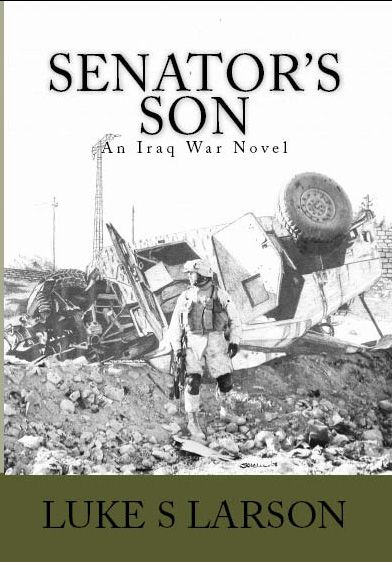
Senator’s Son: An Iraq War Novel
Fiction is not a genre that I usually review here, or get an opportunity to read often, but I received a courtesy review copy of a book Senator’s Son, by Iraq war vet, Marine officer and new novelist Luke Larson and was curious. The Iraq War and the War on Terror have produced a fine array of thoughtful books by veterans, war reporters and military thinkers like Fiasco, One Bullet Away and The Strongest Tribe, all of which were non-fiction memoirs, journalistic histories and quasi-policy books. By virtue of writing Senator’s Son as a novel, Larson was taking a different path in explaining his war.
There are two books at once in Senator’s Son. The first, is of course, a story, with characters and a plot and rising action, action, tragedy and theme – all the usual aspects of literature which I am not especially practiced at evaluating here. The second part is a contextual explanation of COIN by an author who lived the Iraq War. To his credit, Larson contacted me personally to request a “No bulls**t review”, so I will give the man what he asked for.
As an explanation of COIN, I think the book is a must read for anyone unfamiliar with the subject and the nuanced complexities that COIN entails. The gritty, unforgiving, human suffering and moments of triumph of soldiers waging “pop-centric” COIN that gets lost in powerpoint slides, in the dry abstractions of journal articles and blogospheric arguments far removed from the ground is present in ample measure in Senator’s Son. Many times, I paused in a passage and thought, “hmmm….I did not consider that”. Or “This is what the soldiers bear up under without complaint”. More people need to read that and digest what we ask of our men and women in Iraq and Afghanistan.
Senator’s Son also lays out, fairly methodically, how COIN theory may have been interpreted and debated by soldiers outside the wire, including cameo appearances or mention of real life COIN leaders woven into the story. The characters Bama, Cash, Rogue, Isaac, Gonzo the Iraqi and more, resist and adapt, struggling with their environment, unseen enemies and the political pressures of higher authorities, registering both frustration and progress in executing the mission of Golf Company. There’s even diagrams. If Senator’s Son is not on official COIN reading lists, it should be.
As a pure novel, judged on literary standards, Senator’s Son reflects its’ status as a “first novel” of a talented author whose vision of the craft is emerging. Larson excels at creating scenarios, staccato vignettes for the characters to act ( Larson may also have a future as a screenwriter – his book naturally flows in the mind like a movie). There’s always a believable, environmental, “texture” present that exceeds that of short story and science fiction writers, yet as a novelist, Larson leaves enough to the reader’s imagination so that the story moves at a dramatic pace.
Characterization in Senator’s Son is uneven. It takes a while for the individual personalities of the characters to shine beyond their common “Marine-ness” and we get only the briefest glimpse of the malign nature of the enemy, and that secondhand through the eyes of an Iraqi character. That probably is an accurate representative of the experience of most US soldiers and Marines in Iraq who are not interrogators; furthermore, having the antagonist that the characters struggle against be the total environment is perfectly legitimate. It would have been interesting for me to have seen how Larson would develop and utilize a figure who was the focus of evil; however that task would be fairly incompatible with getting an effective message across regarding COIN, success of which does not hinge on the defeat of super-villains or the resolution of black-white moral absolutes but is complexity written in shades of gray.
Finally, as an avid reader, I found Senator’s Son to be a page-turner. Several times, I looked at the clock while reading for what seemed to me a short time, noted it was 1:30 am and was regretful that I had to put it on my bedstand ( I always finished the chapter first though 🙂 ) only to repeat the process the following night. Strongly recommended.
ADDENDUM – OTHER REVIEWS of SENATOR’S SON by:

Zenpundit is a blog dedicated to exploring the intersections of foreign policy, history, military theory, national security,strategic thinking, futurism, cognition and a number of other esoteric pursuits.
Customized Web Site & Blog Design

