zenpundit.com » reading

Archive for the ‘reading’ Category

Education, Books and the Digital Age

Wednesday, March 24th, 2010

 

In one of those “Socrates lamenting how the young folk can’t memorize and recite worth a damn because of all the time they waste reading!” moments, The New York Times hosted a debate of cultural significance. The authors are all thoughtful and reasonable in their contentions:

Do School Libraries Need Books?

Keeping traditional school libraries up to date is costly, with the constant need to acquire new books and to find space to store them. Yet for all that trouble, students roam the stacks less and less because they find it so much more efficient to work online. One school, Cushing Academy, made news last fall when it announced that it would give away most of its 20,000 books and transform its library into a digital center.

Do schools need to maintain traditional libraries? What are the educational consequences of having students read less on the printed page and more on the Web?

I spend a copious amount of time reading online with a PC, Blackberry, netbook and a Kindle but there’s something sad and sterile about the concept of a library without books. It is like calling a room with an iPod plugged into a Bose a “concert hall”.

This isn’t an antiquarian reaction. I am enthusiastic about the potential and the evolving reality of Web 2.0 as a powerful tool for learning, to set “minds on fire“, to facilitate mass collaboration in open-source  communities of practice, to lower costs and increase access to the highest quality educational experiences available and to drastically re-engineer public education. I am all for investing in “digital centers” for the “digital natives” – hell, all students should be carrying netbooks as a standard school supply! The capacity to skillfully navigate, evaluate and manipulate online information is not an esoteric accomplishment but an everyday skill for a globalized economy. Going online ought to be a normal part of a child’s school day, not a once a month or semester event.

I am also sympathetic to the economic questions facing school librarians – and not merely of cost, but of physical space. School library budgets are shrinking or nonexistent even as digital data compression and processing power follows Moore’s Law. Digital investment, especially when most vendors that specialize in k-12 educational markets feature egregiously oligopolistic, rip-off, prices, gives librarians an orders of magnitude larger “bang for the buck”.

But abandoning books entirely is not the way to go. Cognitively, reading online is likely not the same at the neuronal level as reading from a book. For literate adults, that may not matter as much as for children who are still in the complicated process of learning how to read. The key variable here may be visual attention moreso than particular cognitive subsets of reading skills, but we don’t actually know. Science cannot yet explain the wide developmental and methodological preference variation  among students who learn or fail to learn how to read using the ancient dead tree format. To quote neuroscientist, Dr. Maryanne Wolf:

….No one really knows the ultimate effects of an immersion in a digital medium on the young developing brain. We do know a great deal, however, about the formation of what we know as the expert reading brain that most of us possess to this point in history.

In brief, this brain learns to access and integrate within 300 milliseconds a vast array of visual, semantic, sound (or phonological), and conceptual processes, which allows us to decode and begin to comprehend a word. At that point, for most of us our circuit is automatic enough to allocate an additional precious 100 to 200 milliseconds to an even more sophisticated set of comprehension processes that allow us to connect the decoded words to inference, analogical reasoning, critical analysis, contextual knowledge, and finally, the apex of reading: our own thoughts that go beyond the text.

This is what Proust called the heart of reading – when we go beyond the author’s wisdom and enter the beginning of our own.

I have no doubt that the new mediums will accomplish many of the goals we have for the reading brain, particularly the motivation to learn to decode, read and experience the knowledge that is available. As a cognitive neuroscientist, however, I believe we need rigorous research about whether the reading circuit of our youngest members will be short-circuited, figuratively and physiologically.

For my greatest concern is that the young brain will never have the time (in milliseconds or in hours or in years) to learn to go deeper into the text after the first decoding, but rather will be pulled by the medium to ever more distracting information, sidebars, and now,perhaps, videos (in the new vooks).

The child’s imagination and children’s nascent sense of probity and introspection are no match for a medium that creates a sense of urgency to get to the next piece of stimulating information. The attention span of children may be one of the main reasons why an immersion in on-screen reading is so engaging, and it may also be why digital reading may ultimately prove antithetical to the long-in-development, reflective nature of the expert reading brain as we know it.

I could make a cultural argument about the tactile pleasure of book reading. Or the intrinsic role of books as the cornerstone of cultivating a “life of the mind” . Or that book-bound literacy is a two thousand year old element of Western civilization that is worth preserving for its own sake – which it is. However, such cultural arguments are not politically persuasive, because if you understand them already then they do not need to be made. And if you do not understand them from firsthand experience, then you cannot grasp the argument’s merit from a pious secondhand lecture.

Which leaves us with an appeal to utilitarianism; bookless schools might result in students who read poorly, which wastes money, time, opportunities and talent. Online mediums should be a regular part of a student’s diet of literacy but without books as a component of reading, a digital environment may not make for a literate people.
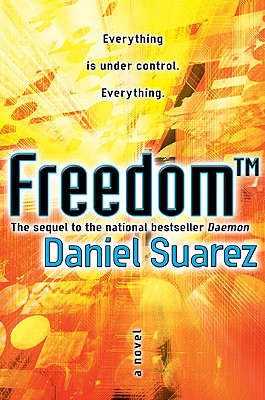
Freedom(TM) by Suarez

Tuesday, March 23rd, 2010


Freedom (TM) by Daniel Suarez

Shlok and John Robb have already endorsed Freedom(TM) by Daniel Suarez, the sequel to his earlier bestselling Daemon and I’d like to briefly join them in praising Freedom(TM) as a must-read work of science fiction. One that meshes well with the societal problems covered on today’s front pages while describing an emergent world of the Darknet being shepherded by the elusive, increasingly powerful, Daemon.

Other Posts on Freedom(TM):

Red Herrings

The Need for Old Hands: Mackinlay on Old COIN

Friday, March 19th, 2010

Currently reading The Insurgent Archipelago by John Mackinlay. Not finished yet but I found this passage striking:

….The ratio of coloniser to colonised – and of the tiny British contingent to the vast numbers of the native population – suggested that a degree of consent to their presence was already inherent. The officials in each colony were competitively selected from an educated and ambitious British upper class, in many cases they were talented and intrepid men, used to living and campaigning in the field, with an intelligent grasp of their territory, its people, languages and culture. They survived and succeeded on their wits, natural authority and knowledge. When the colonised population rose up in insurrection and military force was rushed to the scene, it was subordinated to these same British administrators who became responsible for the direction of the campaign. All the problems of devising a political strategy, ensuring the legitimacy of the military actions and restoring the structures of governance were taken care of by a familiar hub of individuals. It was a continuously reconvening club in which personal relationships tended to override the ambiguities of their civil-military partnership.
Admittedly, there’s a shiny high gloss of romantic nostalgia for the Raj here, polishing the historical reality. The British Empire also saw examples of arrogance or cruelty by British colonial officials that helped provoke uprisings like the Sepoy Mutiny. Or, high-level imperial administrators could zealously pursue local colonial expansion, as Viscount Milner did in starting the needless Second Anglo-Boer War, which partially involved putting down a grueling Trekboer insurgency, that ultimately weakened the Empire at the strategic level.

Those calamities, as expensive and bloody as they were, were exceptions. Mackinlay is correct in assessing the value of Britain’s colonial administrative class, whose deliberate cultivation of “Old Hands” permitted a sixth of the earth’s surface to be ruled relatively cheaply from Whitehall. Lord Milner, for all his faults, could at least speak to President Kruger in his own language and understood the Boer states on which he was waging war, even if he disdained the Afrikaner settlers. It’s hard to imagine many American statesmen or senior generals (or sadly, CIA agents and diplomats) fluently debating foreign counterparts in Arabic, Pashto, Farsi or Chinese. British officialdom took the time – and had the time, professionally – to learn the languages, dialects and customs of the peoples with whom they allied or fought, conquered and ruled.

Not so in contemporary peacekeeping /crypto-COIN operations , according to Mackinlay:

By the 1990’s the colonial officials who had been the key element in every operation since Cardwell were now missing. Coalition forces were intervening in countries that were the antithesis of the former colonies, where the incoming military were regarded as occupiers and where there was no familiar structure of colonial officials and district officers to be seen. Moreover, the diplomats who belatedly attempted to fill this role, although no doubt intellectually brilliant, crucially lacked the derring-do, local credibility and natural authority of their colonial era predecessors. A few extra hands from the Foreign Office or the State Department could not compensate for the loss….

….Although at a local level the British counter-insurgent techniques proved to be successful, broader problems presented themselves as a result of an absence of strategy and a failure of campaign design, particularly in the civil-military structures. It was simply not a realistic option to fill the void left by the departure of a national government – with all its natural expertise and authority – with a band-aid package of contracted officials and flat-pack embassies.

New Hands cannot act or think like Old Hands. They lack not only the in-country experience and linguistic skills but the entire worldview and personal career interests of the American elite mitigate against it. “Punching tickets” is incompatible with becoming an Old Hand and aspiring to be an Old Hand is incompatible with continued employment at most foreign policy agencies of the USG.

American Foreign Service Officers, CIA personnel and flag officers never had the same historical frame of reference as their Imperial British cousins, but the culture of the Eastern Establishment approximated a high church Yankee Republican version that provided an elan, a worldly knowledge and moral certitude until the Establishment’s will to power and self-confidence was broken by the Vietnam War. Subsequent generations of American elite have been indoctrinated in our best institutions to instinctively distrust the marriage of cultural knowledge and political skills to the service of advancing national interest as “Orientalism“.

I am not an admirer of Edward Said but the man was no fool. He understood the strategic importance for his radical political faction of populalrizing the de-legitimization the learning of other cultures and languages as immoral for any reason except partisanship in their favor against the interests of the predatory West. This is why something as esoteric and parsimoniously funded as “Human Terrain Teams” meet with volcanic rage from  academic leftists, especially in the fields of anthropology and political science. This is the sort of censorious mindset that would have  made the works of Herodotus, Alexis de Tocqueville, the Marquis de Custine, Richard Francis BurtonT.E. Lawrence, Ruth Benedict, Rene GroussetRaphael Patai and Bernard Lewis, to name just a few, impossible.

Recovering our capacity to act effectively and see with clarity requires the training of a new generation of Old Hands to interpret and act as policy stewards and agents in regions of the world in which most Americans are unfamiliar and likely to remain so. Current academic PC ideological fetishes reigning at our Ivy League universities artificially shrink our potential talent pool. Alternative educational pathways through military service academies, think tanks, professional and Cross-cultural associations and better USG training programs need to be developed to route around the university gateway that is largely in control of keepers hostile or indifferent to American foreign policy objectives. By the same token, USG agency and military personnel and security clearance policies need a systemic overhaul to better take advantage of those already in service who find their career paths blocked or frustrated.

We waste talent on a massive scale.

Review: Senator’s Son by Larson

Monday, March 15th, 2010

larson.jpg

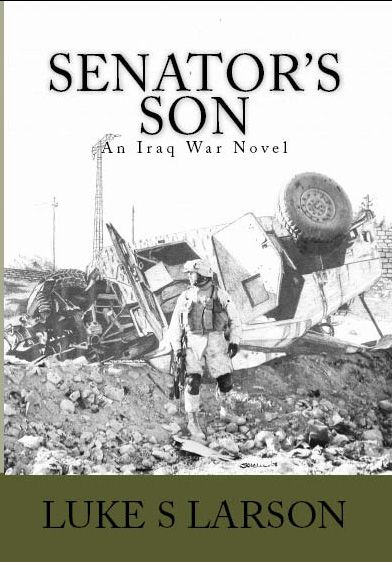
Senator’s Son: An Iraq War Novel by Luke S. Larson

Fiction is not a genre that I usually review here, or get an opportunity to read often, but I received a courtesy review copy of a book Senator’s Son, by Iraq war vet, Marine officer and new novelist Luke Larson and was curious. The Iraq War and the War on Terror have produced a fine array of thoughtful books by veterans, war reporters and military thinkers like FiascoOne Bullet Away  and The Strongest Tribe, all of which were non-fiction memoirs, journalistic histories and quasi-policy books. By virtue of writing Senator’s Son as a novel, Larson was taking a different path in explaining his war.

There are two books at once in Senator’s Son. The first, is of course, a story, with characters and a plot and rising action, action, tragedy and theme – all the usual aspects of literature which I am not especially practiced at evaluating here. The second part is a contextual explanation of COIN by an author who lived the Iraq War. To his credit, Larson contacted me personally to request a “No bulls**t review”, so I will give the man what he asked for.

As an explanation of COIN, I think the book is a must read for anyone unfamiliar with the subject and the nuanced complexities that COIN entails. The gritty, unforgiving, human suffering and moments of triumph of soldiers waging “pop-centric” COIN that gets lost in powerpoint slides, in the dry abstractions of journal articles and blogospheric arguments far removed from the ground is present in ample measure in Senator’s Son. Many times, I paused in a passage and thought, “hmmm….I did not consider that”. Or “This is what the soldiers bear up under without complaint”. More people need to read that and digest what we ask of our men and women in Iraq and Afghanistan.

Senator’s Son also lays out, fairly methodically, how COIN theory may have been interpreted and debated by soldiers outside the wire, including cameo appearances or mention of real life COIN leaders woven into the story. The characters Bama, Cash, Rogue, Isaac, Gonzo the Iraqi and more, resist and adapt, struggling with their environment, unseen enemies and the political pressures of higher authorities, registering both frustration and progress in executing the mission of Golf Company. There’s even diagrams. If Senator’s Son is not on official COIN reading lists, it should be.

As a pure novel, judged on literary standards, Senator’s Son reflects its’ status as a “first novel” of a talented author whose vision of the craft is emerging. Larson excels at creating scenarios, staccato vignettes for the characters to act ( Larson may also have a future as a screenwriter – his book naturally flows in the mind like a movie). There’s always a believable, environmental, “texture” present that exceeds that of short story and science fiction writers, yet as a novelist, Larson leaves enough to the reader’s imagination so that the story moves at a dramatic pace.

Characterization in Senator’s Son is uneven. It takes a while for the individual personalities of the characters to shine beyond their common “Marine-ness” and we get only the briefest glimpse of the malign nature of the enemy, and that secondhand through the eyes of an Iraqi character. That probably is an accurate representative of the experience of most US soldiers and Marines in Iraq who are not interrogators; furthermore, having the antagonist that the characters struggle against be the total environment is perfectly legitimate. It would have been interesting for me to have seen how Larson would develop and utilize a figure who was the focus of evil; however that task would be fairly incompatible with getting an effective message across regarding COIN, success of which does not hinge on the defeat of super-villains or the resolution of black-white moral absolutes but is complexity written in shades of gray.

Finally, as an avid reader, I found Senator’s Son to be a page-turner. Several times, I looked at the clock while reading for what seemed to me a short time, noted it was 1:30 am and was regretful that I had to put it on my bedstand ( I always finished the chapter first though 🙂 ) only to repeat the process the following night.  Strongly recommended.

ADDENDUM – OTHER REVIEWS of SENATOR’S SON by:

Thomas P.M. Barnett 

Shrinkwrapped 

Shane Deichman

What Would You Want in an E-book?

Tuesday, March 2nd, 2010

My amigo, the novelist Steven Pressfield, is considering writing a sequel to his The War of Art, but in E-book form:

Writing Wednesdays #27: “Help!”

….Here’s the issue. I’m thinking about writing a follow-up to The War of Art. Sort of a War of Art 2.0. Some things I’d like to know from your perspective are:

1) Would you be interested in such a book? (Tell the brutal truth; don’t be kind.) Would you consider buying it?

2) In what ways would such a book be most helpful to you? As a motivational aid? A kick in the butt? For further insights on Resistance? On professionalism? Something else?

I have my own ideas on these issues, but it would help me a lot to hear what you think.

3) If War of Art 2.0 could be exactly what you want, what would it be? If it had three main sections, what would they be? If the book could deliver a specific feeling as you closed the final page, what would that feeling be?

Would it be like the original War of Art or would it be different? In what ways?

5) Does it matter to you if the book comes out in hardcover? (It doesn’t to me.) Would paperback be just as good? What if it was released as an eBook that you had to download and print out-is that worthwhile or a pain in the butt?

I’m thinking of constructing the book so that it could be read on an iPad-in other words, including video or links along with the text. If you were reading it on an iPad or other such device, what type of videos would you like to see included?

Some years back, I was briefly involved in some preliminary discussions with venture capitalist Dave Davison, on how to take a book and make it into an extended Web 2.0 experience. This was well before the Kindle or the Nook and a designated platform did not exist. Ideas were kicked around with a designer, but nothing ever came of it, being just a little too far ahead of the technology.

My question is: What additional features would you like to have with an E-book that you do not have now? Regardless of the content, what would you like an E-book to do in terms of an experience beyond just providing you with a text?


Switch to our mobile site