zenpundit.com » computers

Archive for the ‘computers’ Category

We’re a legacy industry in a world of start-up competitors

Wednesday, August 26th, 2015

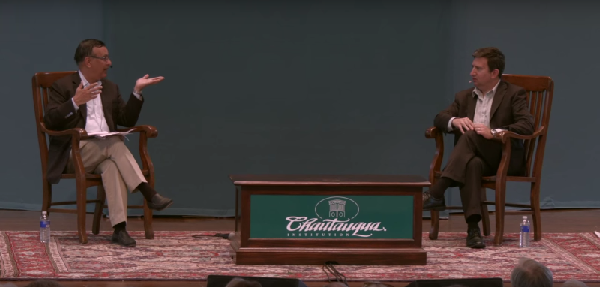
[ by Charles Cameron — Ambassador Husain Haqqani and Daveed Gartenstein-Ross at Chautauqua ]
.
chautauqua haqqani daveed

**

From the outset, when cheers went up for Daveed’s birthplace, Ashland, Oregon, and Ambassador Haqqani’s, Karachi — and for the brilliant meeting of the minds that is Chautauqua — it was clear that we were in the presence of two gracious, witty and informed intelligences, and the seriousness of the conversation between them that followed did nothing to reduce our pleasure in the event. Daveed called it “easily the best experience I have ever had as a speaker.”

I’ll highlight some quotes from each speaker, with the occasional comment:
**

Amb. Haqqani:

None of the countries except Egypt, Turkey and Iran, none of the countries of the Middle East are in borders that are historic, or that have evolved through a historic process. And that’s why you see the borders a straight lines. Straight lines are always drawn by cartographers or politicians, the real maps in history are always convoluted because of some historic factor or the other, or some river or some mountains.

You’ll see how neatly this fits with my recent post on borders, No man’s land, one man’s real estate, everyone’s dream?

And now that whole structure, the contrived structure, is coming apart.

Then most important part of it is, that this crisis of identity – who are we? are we Muslims trying to recreate the past under the principles of the caliphate .. or are we Arabs, trying to unify everybody based on one language, or are we these states that are contrived, or are we our ethnic group, or are we our tribe, or are we our sect? And this is not only in the region, it’s also overlapping into the Muslim communities in the diaspora..

**

If Amb. Haqqani emphasized the multiple identities in play in the Arabic, Islamic, Sunni, Shia, Sufi, and tribal worlds in his opening, Daveed’s emphasis was on the failure of the post-Westphalian concept of the nation state.

Daveed G-R:

In the economic sphere there’s this thing that is often called “legacy industries” – industries that fit for another time, but are kind of out of place today. Think of Blockbuster Video, once a massive, massive corporation.. that’s a legacy industry. So when Ambassador Haqqani talks about how it’s not just in the Middle East that we have this crisis of identity, I think the broader trend is that the Westphalian state that he spoke about, the kind of state that was encoded after the Peace of Westphalia, looks to a lot of people who are in this generation of the internet where ideas flow freely, it looks like a legacy industry.

Why do you need this as a form of political organizing? And what ISIS has shown is that a violent non-state actor, even a jihadist group that is genocidal and implements as brutal a form of Islamic law as you could possibly see, it can hold territory the size of Great Britain, and it can withstand the advance of a coalition that includes the world’s most powerful countries including the United States. And what that suggests is that alternative forms of political organization can now compete with the nation state.

**

The Ambassador then turned to the lessons we should take from 1919’s US King–Crane Commission, reporting on the break-up of the Ottoman Empire — they concluded that it gave us

a great opportunity — not likely to return — to build .. a Near East State on the modern basis of full religious liberty, deliberately including various religious faiths, and especially guarding the rights of minorities

— down to our own times.

Amb. Haqqani:

What we can be sure of is that the current situation is something that will not be dealt with without understanding the texture of these societies. So for example, when the United States went into Iraq without full understanding of its sectarian and tribal composition, and assumed that, all we are doing is deposing a dictator, Saddam Hussein, and then we will hold elections and now a nice new guy will get elected, and things will be all right -– that that is certainly not the recipe. So what we can say with certainty in 2015 is .. over the last century what we have learnt is: outsiders, based on their interests, determining borders is not a good idea, and should certainly not be repeated. Assuming that others are anxious to embrace your culture in totality is also an unrealistic idea.

The sentence that follows was a stunner from the Ambassador, gently delivered — a single sentence that could just as easily have been the title for this post as the remark by Daveed with which I have in fact titled it:

Let me just say that, look, he ideological battle, in the Muslim world, will have to be fought by the likes of me.

Spot on — and we are fortunate the Ambassador and his like are among us.

**

Daveed then turned to another topic I have freqently emphasized myself.

Daveed G-R:

The power of ideas – we as Americans tend not to recognize this when it falls outside of ideas that are familiar to us. So one thing that the US has been slow to acknowledge is the role of the ideology that our friend and ally Saudi Arabia has been promulgating globally, in fomenting jihadist organizations.

And one of the reasons we have been slow to recognize that. I mean one reason is obvious, which is oil. .. But another reason has been – we tend to think of ideas that are rooted in religion – as a very post-Christian country – we tend to think of them as not being real – as ideas which express an ideology which is alien to us –as basically being a pretext, with some underlying motivation which is more familiar to us. That it must be economics, or it must be political anger. I’m not saying those are irrelevant, they’re not – but when Al-Qaida or ISIS explains themselves, taking their explanation seriously and understanding where they’re coming from – not as representatives of Islam as a whole, but as representatives of the particular ideology that they claim to stand for – we need to take that seriously. Because they certainly do.

**

Amb. Haqqani:

The world is not a problem for Americans to solve, it’s a situation for them to understand.

This makes a nice DoubleQuote with Gabriel Marcel‘s more general aphorism:

Life is not a problem to be solved but a mystery to be lived.

**

Toward the end of the discussion, Daveed touched on some ideas of recurrent interest to Zenpundit readers..

Daveed G-R:

Looking at the US Government, questions that I ask a lot are: Why are we so bad at strategy? Why are we so bad at analysis? Why do we take such a short term view and negate the long term?

He then freturned to the issue of legacy industries and nation-states:

Blockbuster is a legacy industry. And the reason why legacy industries have so much trouble competing against start-up firms, is because start-ups are smaller, it’s more easy for them to change course, to implement innovative policies, to make resolute decisions – they can out-manoeuver larger companies. And so larger companies that do well adapt themselves to this new environment where they have start-up competitors. Nation-state governments are legacy industries. Violent non-state actors are start-up compoetitors.

— and had the final, pointed word:

We’re a legacy industry ina world of start-up competitors.

**

Having offered you these tastes, at this point I can only encourage you to watch the whole hour and a quarter, filled to the brim with incisive and articulately-stated insights:
Class distinction: these games got played

Tuesday, April 14th, 2015

[ by Charles Cameron — who just realized the Lotto would be as hard for a machine to beat as his own HipBone Games ]
.

SPEC lotto chess cheats

**

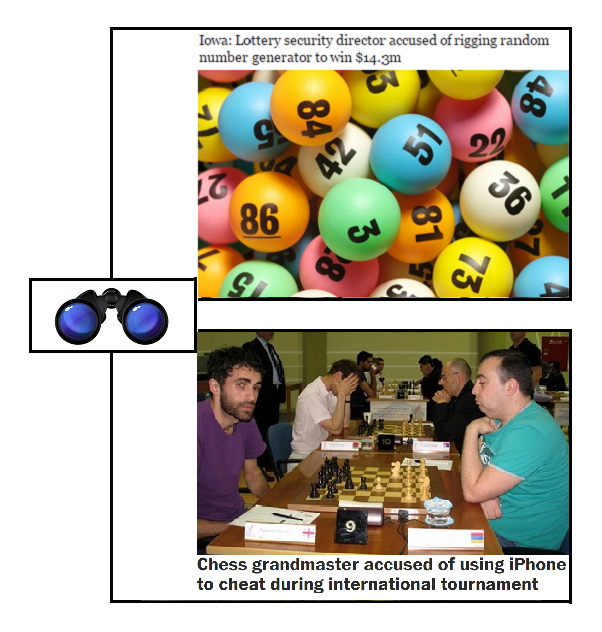
A friend pointed me to the Washington Post’s story of a chess grandmaster caught cheating with help from an iPhone today, and the phrase “a simple cellphone can transform anybody into a grandmaster” struck home immediately. Not possible, I tweeted, with games of analogy, HipBone, Sembl &c, the human being, not the computer, is key — in games, intel analysis, etc. Big data crunches well, I continued, but the human mind digests!

Y’see, I’m somewhat proud of the fact that my HipBone Games would be more difficult than Chess — more difficult even than Go — for a computer like IBM’s Watson to play at grandmaster level.

And then my eye was caught by the parallel story of an IT specialist who goes up for trial on Monday on charges of “fixing” himself a winning Lotto ticket.

Lotto is way downmarket compared to Chess. no? And the prize for the winner of the 17th annual Dubai Open Chess Tournament was $12,000, whereas the lucky Lotto winner’s grab netted him $14.3 million. Go figure, and use your smartphone if you wish.

Could Watson beat the Lotto? I don’t believe it could. Does that make Lotto more upscale — more demanding, more difficult or an AI to fudge — than my HipBone Games? Maybe it does : (

Ah well.

In any case, human beats random number generator — score yet another win for the human mind!

**

Sources:

  • Washington Post, Chess
  • International Business Times, Lotto
  • Moore’s Law responsible for Shades of Grey

    Sunday, April 12th, 2015

    [ by Charles Cameron — confirmed: that as the power of computing increases, all color is drained from our lives.. ]
    .

    **

    Brought to you by DoubleQuotes in the Wild.

    And now, the “Most Dangerous” finalists

    Monday, March 30th, 2015

    [ by Charles Cameron — a man vs machine contest, with the betting shops favoring.. ]
    .

    The semi-finals have been conducted, contested and concluded, with judges Elon Musk:

    and The Republicans:

    **

    The final round is upon us.

    In a definitive Man vs Machine match to be adjudicated by The Turn of Events, we shall see whether artifical intelligence, slouching towards Bethlehem, is more dangerous than the sitting President, suffering under — or perhaps liberated by — the two-term limit on his office..

    Who or what will win the Most Dangerous of All belt, and end-of-the world cash prize that goes with it?

    According to noted statistician Nate Silver of FiveThirtyEight..

    Variations on the Blue Screen of Death

    Saturday, March 7th, 2015

    [ by Charles Cameron — where would we be without our digital devices, minds & memories? ]
    .

    Two converging thoughts, the first from John Robb at Global Guerrillas:

    Over the weekend, ISIS threatened the life of Jack Dorsey, a co-founder and Chairman of Twitter. Why? Twitter, at the urging of the US government, has been shutting down the accounts of ISIS supporters for months. So, ISIS supporters responded by making a threat with a nifty graphic:

    IS warns Dorsey the Twitter CEO Robb GG

    We told you from the beginning it’s not your war, but you didn’t get it and kept closing our accounts on Twitter, but we always come back. But when our lions come and take your breath, you will never come back to life

    The CEO as an Objective of War

    Unfortunately for the suits in Silicon Valley, ISIS isn’t as much of a pushover as al Qaeda was. They have mass and
    momentum and they are smart enough to understand the role of the Internet in this struggle. Additionally, they have lots of experience coercing CEOs. They did it quite a bit of it during the war in Iraq (and it worked).

    Regardless, the targeted killing of a well known tech executive in sunny California by ISIS jihadis does appear impossible to imagine. Few places are more remote from each other, and not just geographically. Silicon Valley is a hyperconnected, financially mainlined zone striving for a tech nirvana. ISIS is a disconnected autonomous zone striving to return to the 7th Century. However, that’s probably a bad assumption. Charlie Hebdo showed the world that terrorism is evolving and corporate targeting on global scale is now on the agenda. This means an attack on a tech CEO isn’t just possible, but probable. Worse, once an attack on a senior tech executive happens, future threats will be instantly credible and highly coercive..

    If that occurs, we are going to find out very quickly that the corporation, and particularly tech companies, are particularly bad organizations for warfare. One reason is that they are too centralized. In particular, the institution of the CEO is a grave weakness (a systempunkt in global guerrilla lingo). The CEO’s centrality to the corporate network makes him/her a single point of failure for the entire organization. Another is that executives in most of the western world are very soft targets. Easy to find (Google and Google maps), easy to isolate, and easy to kill…

    **

    And the second from Marc Lindemann, When the Screens Go Dark: Rethinking Our Dependence on Digital Systems, from Small Wars Journal:

    In a threat environment where even the most useful digital system may be knocked out of the fight, there needs to be a back-to-basics approach that will enable units to continue to fight effectively in the absence of their digital systems and digital guidance from higher headquarters. Every commander should be able to shut off the TOC’s power, slipping the digital leash, and have confidence that his or her unit can continue to function. Junior leaders and staff sections should be able to anticipate the problems inherent in digital-system failure and know what to do without a major disruption in TOC operations. ADRP 6-0’s non-digital solutions – “establishing trust, creating shared understanding, or providing a clear intent using mission orders” – are significant. More significant, however, and more measurable is the degree of Soldiers’ basic proficiency in their warfighting tasks.

    Conclusion

    Although this paper does not and cannot advocate the abandonment of the U.S. Army’s existing digital systems, the U.S Army’s dependence on digital systems is very much on its leaders’ minds today. These systems have repeatedly demonstrated the potential to make the U.S. Army a much more efficient and lethal fighting force. Before his retirement, however, GEN Robert W. Cone, then Commanding General, U.S. Army Training and Doctrine Command, gave digital systems an ultimatum: “Why do we want this piece of technology? If it does not dramatically improve training ef?ciency, we need the strength to walk away.” Right now, the military is poised to increase digital training requirements in pursuit of inter-service operations, multinational activities, and the expansion of the network to include all Soldiers and vehicles. Leaders at every level must understand their dependence on digital systems, successfully manage their units’ use of these systems, and promote decentralized initiative in support of clearly defined and mutually understood tactical goals. In the end, Soldiers must have tactical knowledge that transcends anything displayed on a computer monitor. Soldiers, not our digital systems, are what will win our future conflicts. When the screens go dark, the mission must go on.

    Well, the military details are way beyond me, though they presumably make sense to other SWJ and ZP readers — but the idea that the net, or large domains within it, may suddenly go dark (or blue, as the saying goes) is one that should give each one of us, dependent as we are on digital media for our communications and memories, considerable plause.

    **

    It was my friend Peter Rothman — currently editor of H+ Magazine — who wrote the now celebrated digital haiku a few years back:

    Windows NT crashed.
    I am the Blue Screen of Death.
    No one hears your screams


    Switch to our mobile site

