zenpundit.com » philosophy

Archive for the ‘philosophy’ Category

The Mob of Virtue

Sunday, August 1st, 2010
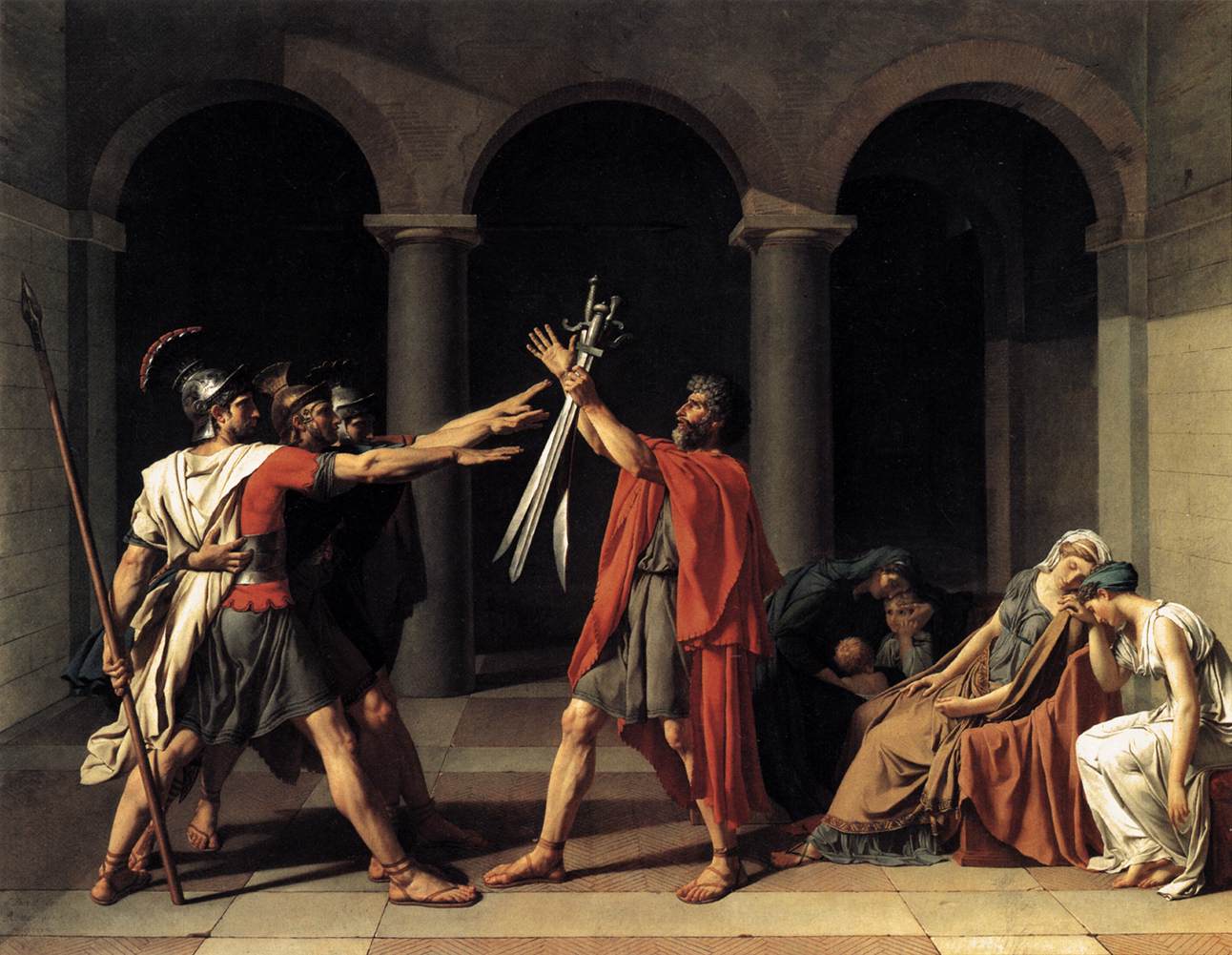
 

Small “r” republican virtue, to be precise.

A wise man once told me that a weakness of our Constitutional system was that the Framers implicitly presumed that people of a truly dangerous character, from bullies to bandits to political menaces to the community, would primarily be dealt with in age-old fashion by outraged neighbors whose rights had been trespassed and persons abused one time too many. They did not prepare for a time when communities would be prohibited from doing so by a government that also, as a whole, had slipped the leash. Indeed, having read LockeMontesquieuCicero, Polybius, Aristotle and Plato, they expected that such a state of affairs was “corruption” of the sort that plagued the Old World and might happen here in time. A sign of cultural decadence and political decay. They gave Americans, in the words of Benjamin Franklin, “A republic, if you can keep it”. It remains so only with our vigilance.

It is happening now.

We have forgotten – or rather, deliberately been taught and encouraged to forget – the meaning of citizenship.

We have let things slip.

Joseph Fouche superbly captures this implicit element, the consequences of the loss of fear of  informal but very real community sanction, in his most recent post:

People Like Us Give Mobs a Bad Name

….A classic American mob could exhibit any or all of these strategies. It could be a saint inciting a mob to attack others who deviated from a shared narrative. It could be a knave in saint’s clothing inciting an attack on personal rivals. It could be a moralist inciting a mob against the local knaves. The one constant is that an American mob was an expression of communal self-government by moralists seeking to punish what they saw as deviant, even if its manifestation was frequently unpleasant. It was a sign the local people were engaged.

Samuel Adams was the Lenin of the American Revolution. He conceived a hatred for the British Empire and a desire for American independence well before anyone else did. Adams skillfully used mobs alongside legal pretense to incrementally spread his agenda. Others followed his example. In the Worcester Revolution of 1774, the local population shut down the normal operations of royal government in west and central Massachusetts and drove royal officials out of those regions (the book to read is Ray Raphael’s The First American Revolution: Before Lexington and Concord). The British crown lost control of inland Massachusetts before Lexington and Concord were even fought.

However, eleven years later, when many of the same local residents attempted to do the same thing in protest of the policies of a now independent Massachusetts, the state government put down their rebellion with Samuel Adams’s strong support. The difference? An apocryphal remark attributed to Adams captures some of the truth behind his attitude: “the man who dares to rebel against the laws of a republic ought to suffer death”. Mobs protesting the actions of an unrepresentative government like the British Parliament, Adams argued, were valid. Mobs protesting the actions of a representative government like Massachusetts’s state government, on the other hand, were treasonous. This doctrine, supported by other Revolutionary leaders, especially the cabal behind the Order of the Cincinnati, was eventually enshrined as the higher law of the land in the slow motion coup d’etat that overthrew the Articles of Confederation and replaced it with the more authoritarian United States Constitution in 1787-1788.

While mobs continued to combine, they were gradually neutered by the conscious agenda of American elites who sought to replace informal norms enforced by communal censure with formal norms applied under the professional supervision of “wiser heads”. This was a collusion between saints and knaves against moralists. Saints got purer standards that were not reliant on the whims of moralists who got stirred up in unpredictable ways that might violate the saints’ prevailing narrative while knaves got credentials that allowed them to entrench their positions and agendas under the cover of serving a higher good. The same sense of community morality and punishment that gave nineteenth century self-government its vigor and occasional excess was weakened as moralists were tuned out by saints embedded in holy isolation and knaves concerned only with advancing personal priorities. Moralists saw the knaves getting away with free riding off of them and began to opt out, leaving room for more knaves to free ride. For a little formal pretense, the returns on rent seeking were enormous.

The ideal went from a citizenry engaged in self-government to a system designed to advance the best and brightest. Meritocracy sounds good in theory and has some positives in reality. However, a perfect meritocracy is a perfect tyranny. All of the leaders are on once side and all the followers are on the other. This tendency toward the separation of the best from the rest may only be checked by the tendency of those on the ascendant to favor their own children, whatever their merit, over strangers that are more meritorious. This will force some aspiring meritocrats to side with the followers and bring about a rotation of elites. But the transition may take a while and its best to start before you have a meritocratic problem….

Read the whole post here.

Today’s circumstances, with the elite determinedly crafting rules for the mass but not for their class, have an ominous portent for the future of America as a democratic republic, but violence is not yet required.

Political engagement is.

Angelo Codevilla – America’s Milovan Djilas

Tuesday, July 20th, 2010


Older readers may recall the once famous but now largely forgotten Cold War figure of Milovan Djilas. While other dissidents from Communism like Andrei Sakharov, Aleksandr Solzhenitsyn and Whittaker Chambers acheived a more epic historical stature, Djilas was the first high Communist official, the adviser and likely successor to Yugoslavian dictator Tito, to turn against Communism as a system. More importantly, Djilas wrote New Class in 1957, a damning analysis that accurately castigated the hierarchy of Communist Party and government officials an exploitive and tyrannical ruling class that in the Soviet context was later termed “Nomenklatura“. For this act, Djilas would suffer in Tito’s prisons, but he outlived both Tito and Communism and his Party enemies were never able to shake off the truth of his bitter critique.

Claremont scholar and Boston U. international relations professor Angelo Codevilla has published in The American Spectator a very lengthy, often brilliant, sometimes meandering, essay that is part analysis, part cri de coeur, but primarily the most devastating attack on America’s emerging, bipartisan, technocratic Oligarchy that I have ever read:

America’s Ruling Class — And the Perils of Revolution

….Never has there been so little diversity within America’s upper crust. Always, in America as elsewhere, some people have been wealthier and more powerful than others. But until our own time America’s upper crust was a mixture of people who had gained prominence in a variety of ways, who drew their money and status from different sources and were not predictably of one mind on any given matter. The Boston Brahmins, the New York financiers, the land barons of California, Texas, and Florida, the industrialists of Pittsburgh, the Southern aristocracy, and the hardscrabble politicians who made it big in Chicago or Memphis had little contact with one another. Few had much contact with government, and “bureaucrat” was a dirty word for all. So was “social engineering.” Nor had the schools and universities that formed yesterday’s upper crust imposed a single orthodoxy about the origins of man, about American history, and about how America should be governed. All that has changed.

Today’s ruling class, from Boston to San Diego, was formed by an educational system that exposed them to the same ideas and gave them remarkably uniform guidance, as well as tastes and habits. These amount to a social canon of judgments about good and evil, complete with secular sacred history, sins (against minorities and the environment), and saints. Using the right words and avoiding the wrong ones when referring to such matters — speaking the “in” language — serves as a badge of identity. Regardless of what business or profession they are in, their road up included government channels and government money because, as government has grown, its boundary with the rest of American life has become indistinct. Many began their careers in government and leveraged their way into the private sector. Some, e.g., Secretary of the Treasury Timothy Geithner, never held a non-government job. Hence whether formally in government, out of it, or halfway, America’s ruling class speaks the language and has the tastes, habits, and tools of bureaucrats. It rules uneasily over the majority of Americans not oriented to government.

The two classes have less in common culturally, dislike each other more, and embody ways of life more different from one another than did the 19th century’s Northerners and Southerners — nearly all of whom, as Lincoln reminded them, “prayed to the same God.” By contrast, while most Americans pray to the God “who created and doth sustain us,” our ruling class prays to itself as “saviors of the planet” and improvers of humanity. Our classes’ clash is over “whose country” America is, over what way of life will prevail, over who is to defer to whom about what. The gravity of such divisions points us, as it did Lincoln, to Mark’s Gospel: “if a house be divided against itself, that house cannot stand.”

That passage captures the zeitgeist. Read Dr. Codevilla’s article in in its’ entirety here.

I am not in harmony with everything Codevilla has written. Neither is Dr. James Joyner. Codevilla’s personal, very socially conservative, cultural preferences are not mine and, like Joyner, I would quibble with some of his descriptions as immoderate. In general, this essay would have benefited from either having been edited down to be more concise or expanded into a book to leverage greater evidentiary support of diverging political worldviews, which is out there. What is hard to deny though, is that Codevilla is pointing a finger at a visceral problem of a self-aware ruling class in the process of ossifying and separating itself culturally and legally away from and over the ruled – an alien thing in American history. Something the ancient Greeks as well as the Founding Fathers would recognize as anoligarchy“, a threat to democratic self-government and constitutional liberties.

Unlike Milovan Djilas, Angelo Codevilla will not face prison or lose his job for his criticism. Our oligarchy is in its newborn infancy, but it is hungry for power, venal in its corruption, covetous of security, impatient of democratic accountability and intolerant of dissent. Beware of legislative moves, cloaked in high-sounding phrases, to regulate speech, circumscribe criticism of public officials, grant police powers to private corporations like BP, tax farm the many to benefit the few, and generally exclude the public from important policy decisions by making citizen participation in governmental process more complex, opaque, indirect, financially burdensome and personally risky.

If any proposed government action would seem likely to legitimize an activity that would be unethical or illegal if an ordinary person did it, that is a time to make your voice heard against going down the slippery slope.

Breaking the Mother of All Paradigms

Tuesday, July 13th, 2010

“It is, I think, particularly in periods of acknowledged crisis that scientists have turned to philosophical analysis as a device for unlocking the riddles of their field. Scientists have not generally needed or wanted to be philosophers”  

 – Thomas Kuhn

It used to be used as a joke, but a well established string theorist, Erik Verlinde is challenging the existence of gravity, calling it an “illusion” (no word as to whether he is willing to step out of a 95th floor window to test his hypothesis):

The New York Times (Dennis Overbye)A Scientist Takes On Gravity

It’s hard to imagine a more fundamental and ubiquitous aspect of life on the Earth than gravity, from the moment you first took a step and fell on your diapered bottom to the slow terminal sagging of flesh and dreams.

But what if it’s all an illusion, a sort of cosmic frill, or a side effect of something else going on at deeper levels of reality?

So says Erik Verlinde, 48, a respected string theorist and professor of physics at the University of Amsterdam, whose contention that gravity is indeed an illusion has caused a continuing ruckus among physicists, or at least among those who profess to understand it. Reversing the logic of 300 years of science, he argued in a recent paper, titled “On the Origin of Gravity and the Laws of Newton,” that gravity is a consequence of the venerable laws of thermodynamics, which describe the behavior of heat and gases.

“For me gravity doesn’t exist,” said Dr. Verlinde, who was recently in the United States to explain himself. Not that he can’t fall down, but Dr. Verlinde is among a number of physicists who say that science has been looking at gravity the wrong way and that there is something more basic, from which gravity “emerges,” the way stock markets emerge from the collective behavior of individual investors or that elasticity emerges from the mechanics of atoms.

Looking at gravity from this angle, they say, could shed light on some of the vexing cosmic issues of the day, like the dark energy, a kind of anti-gravity that seems to be speeding up the expansion of the universe, or the dark matter that is supposedly needed to hold galaxies together.

….It goes something like this: your hair frizzles in the heat and humidity, because there are more ways for your hair to be curled than to be straight, and nature likes options. So it takes a force to pull hair straight and eliminate nature’s options. Forget curved space or the spooky attraction at a distance described by Isaac Newton‘s equations well enough to let us navigate the rings of Saturn, the force we call gravity is simply a byproduct of nature’s propensity to maximize disorder.

Some of the best physicists in the world say they don’t understand Dr. Verlinde’s paper, and many are outright skeptical. But some of those very same physicists say he has provided a fresh perspective on some of the deepest questions in science, namely why space, time and gravity exist at all – even if he has not yet answered them.

Dr. Verlinde goes into greater detail about his ideas on The Reference Frame, the blog of Czech string theory physicist Luboš Motl. It seems from the comment section that Dr. Motl  is not buying it at all and is politely saying that Verlinde’s hypothesis is complete nonsense ( or, conversely, if true, is so revolutionary that Verlinde upends not only everything we know about physics, but also logic). Here is another expert commentary. Here I cordially invite some of my scientist readers, Shane, Dr. Von and Cheryl to weigh in as well.

Nevertheless, what Verlinde is doing, challenging the unchallenged paradigm, is intellectually very useful.

Sir Isaac Newton who explained gravity’s action did not know what gravity was. We still don’t know what it is even though physicists today have a much wider perspective than did Newton, whose discoveries were the bedrock of not just modern science, but modernity itself. When concepts are accepted blindly we tend to stop thinking of them very deeply. Not everyone, Stephen Hawking has spent a great deal of time pondering gravity as did Albert Einstein in his later years when he groped hopelessly for a unified field theory. Richard Feynman too, was a deep thinker on gravity:

Most of us unfortunately, including most physicists, are not Einstein, Feynman or Hawking.

The difficulty with theoretical physics and questions as fundamental to the order of nature as gravity is that we may be limited in our ability to understand the universe conceptually by the physical, biological, structure of our brains and the scalar level and time frame we inhabit. It is very hard to mentally see outside that box. Our brains can only entertain so many variables or so much complexity at one time and our conceptual imagination is largely influenced by sense perceptions. Mathematics helps us get around our physical limitations as does the processing speed of supercomputers but these crutches themselves refer back to the preferred cognitive avenues of our physical brains.

In thinking about fundamental or overarching phenomena, it is useful to pause and consider that as primates, we may not have been optimized by evolution to easily discern the most significant mechanisms of the physical world when our hominid deep ancestors eluded the apex predators of the Paleolithic Age. With great probability, Verlinde is spectacularly wrong here but his paper, because he is is a credible scientist with an impressive record, is forcing a lot of very smart people to stop and reasses what they know to be true in order to defend it from his heresy – cough…excuse me – his hypothesis 🙂

In doing so, some of them may gain insights of importance that otherwise never might have occurred. Insights that may only be tangentially related to Verlinde’s original idea.

Dissent is the grain of sand that can yield a pearl.

Cameron on “A Translation of Abu Walid al-Masri’s Reply”

Thursday, June 17th, 2010

Charles Cameron, my regular guest blogger, is the former Senior Analyst with The Arlington Institute and Principal Researcher with the Center for Millennial Studies at Boston University. He specializes in forensic theology, with a deep interest in millennial, eschatological and apocalyptic religious sects of all stripes.

Zen here – some background prior to Cameron’s guest post. As I mentioned previously, Charles, a while back, posted a deeply reflective essay here at ZP and at Leah Farrall’s  All Things Counterterrorism, in response to the unusual dialogue that Farrall, a former Australian counterterrorism official, was having with  Abu Walid al-Masri, an Egyptian strategist of jihad, a sometime critic of al Qaida and an adviser to the Taliban. In other words, al-Masri is an influential voice on “the other side” of what COIN theorists like Mackinlay and Kilcullen call the “globalized insurgency” and a theorist of insurgency himself. After some delay, al-Masri responded to Charles, as Farrall described:

Abu Walid al Masri responds to Charles Cameron

Abu Walid  has responded a letter from Charles Cameron. Abu Walid’s response  to Charles can be found here.  You’ll notice when following the link, that he has a new website.It’s well worth a look. There is also an interesting comment from a reader below Abu Walid’s response to Charles; it’s from “one of the victims of Guantanamo”.

As you’ll see from his website Abu Walid is also engaging in a number of other interesting dialogues at the moment, which I am interested to read as they progress.Charles wrote his letter in response to the dialogue Abu Walid and I had a little while back. For those of you new to the site, you can find this dialogue to the right in the page links section.  The letter from Charles can be found on my blog here.

….These letters may not change anything, but they are important because  in mass media sometimes only the most controversial and polarising views tend to make it into the news.I think person to person contact, especially via mediums like this, can go some way to providing opportunities for all of us to discover or be reminded that there is more than one viewpoint and along with differences there are also similarities. Contact like this humanizes people, and in my book that’s never a bad thing.

With that context in mind, we will now let Charles take it away:

A TRANSLATION of ABU WALID al-MASRI’S REPLY

by Charles Cameron

I asked a native-speaking grad student associate of mine to give me a literal translation of Abu Walid’s response to my post, and then tweaked it to give it a reasonable combination of accuracy and fluency, and my associate has kindly given the result his thumbs up — so what follows is probably fairly close to the sense of Abu Walid’s original.

Is this a return to the Age of Chivalry? — Comments on the Response of Charles Cameron

May 31, 2010

Author: Mustafa Hamed, Abu al-Walid al-Masri

MAFA: The Literature of the Outlaws

Charles Cameron’s words, in his comment on the dialog between myself and Ms. Leah Farrall, were wonderful, both for their humanitarian depth and in their high literary style, which makes it difficult for any writer to follow him. He puts me in something of a dilemma, fearing any comparison that might be made between us in terms of beauty of style or depth and originality of ideas — but in my capacity as one of those adventurous “outlaws”, I will try to contemplate, rather than compete with, his response, since this is what logic and reason call for.

Charles Cameron was deeply in touch with the roots of the problem that the world has (justly or unjustly) called the war on terror: it is a cause that relates to the sanctity of the human individual, and his rights and respect, regardless of any other considerations around which the struggle may revolve.

No one can argue about the importance of peace, or the need all humans have for it, nor can anyone argue that war is not hideous, and universally hated.  And yet wars are still happening, and their scope is even increasing.

And now the West claims: it is terrorism — as if war on the face of the earth were the invention of Bin Laden and al-Qaida — and all this, while many others are arguing ever more forcefully that the opposite is true, that al-Qaida and Bin Laden are the invention of war merchants, and that no one can definitely declare as yet — in an unbiased and transparent way — who caused the events of September 11 and the deaths of three thousand persons.

It is not only the one who pulls the trigger who is the killer, as we know —  the one who set the stage for a crime to be committed, who arranges the theatre, and opens the doors, and lures or hires the one who pulls the trigger is even more responsible. He’s the one, after all, who carries away the spoils of the crime, then chases down the trigger-man and finishes him off — not for the sake of justice, nor for love of humanity, but to hide the evidence of the crime, to erase his own fingerprints, and assassinate the witnesses who could implicate him.

For example: was the execution of Saddam Hussein really about bringing justice? Of course not. They executed him after a travesty of a trial for the most trivial of his crimes. Nobody, however, asked him about his most significant crimes — they killed him before he could admit to them, or name the major partners who brought him to the apex of his power, and provided him with a full range of lethal weaponry including weapons of mass destruction, so he could perform mass murder with confidence in his own impunity.

I personally (and here I speak only for myself, so Ms. Farrall need not get irritated) would have preferred to have Charles Cameron as President of the US and a united Europe and the leader of NATO — then there would have been no wars in Afghanistan or Iraq, and the problem of terrorism would have ended in minutes, along with the problems in the Middle East, and nuclear militarization, and even those of poverty and pollution. Why? Because not a single one of these problems can be solved except through the logic of humanitarianism, of justice, and love for people and peace, and hatred of oppression and discrimination between people in any form — we are all the creatures of God, and to Him we shall all return.

I am reminded of Richard the Lionheart, who came to lead a big crusade to capture Jerusalem from Muslim hands. The bloody wars he led brought fatigue to everyone and benefited neither the religious or nor the day-to-day interests of either party. Leading the Muslim campaign was Sultan Salah al-Din al-Ayyubi (Saladin), King Richard’s peer in courage, chivalry and wisdom.

Both parties finally agreed that Jerusalem should remain in Muslim hands — hands which would guarantee its security and that of its people, and of both the Islamic and Christian sanctuaries, preserving their interests and protecting the sanctuaries of all, in peace.

Thereafter, King Richard retreated from Muslim lands, carrying with him a most favorable impression of the Muslims and of Saladin as he returned to his own country, while leaving a continuing memory of respect and appreciation for himself and his chivalry with Saladin and the Muslims — which is preserved in our history books down to the present day.

It was Mr. Cameron’s spirit of fairness, chivalry and true spirituality that reminded me of King Richard’s character — but sadly, it is very difficult to find a ruler in the west like King Richard, and I find it even more regrettable that Muslims should have even greater difficulty finding among themselves a ruler like Saladin.

This is because things are on the wrong track, and people are not in their rightful positions. The wrong people are in power and leading us, while the best among us are weak and under siege.

No human likes or wants this state of affairs — but are the people who are in control of this planet real human beings? Can we consider those who own 50% of the earth’s wealth human, even though they comprise no more than 2% of the human population?

In my opinion, the situation is much worse than these international statistics suggest. I believe the number of those who rule the world is far fewer, and that they own much more. They are the ones who invest in all kinds of wars wherever, and under whatever name or banner, they may be found. The mention of war translates to these people as an immediate waterfall of gold tumbling into their usurious bank vaults, which hold the world — both leaders and led — by the neck.

I speak here of all wars without exception, whether they be the First and Second World Wars, or the wars in Korea and Vietnam, or the First and Second Gulf Wars, or the Third and Fourth, yet to come — whether it be a war in Afghanistan (to hunt for the “Bin Laden and al-Qaida” mirage) or in Iraq (looking for illusory “weapons of mass destruction”) or in Bosnia, Somalia or Africa — that continent of eternal wars for the sake of gold or oil fields — Africa, that colonized continent of disease, covertly modernized in the labs of the secret services and giant pharmaceutical companies.

I wish we could return to the age of chivalry– of courageous and rightly religious knights — for then wisdom would prevail and peace would spread, and we could leave this age of the brokers and merchants of war behind us.

Muslims always call on God to bless them with a leader such as Saladin , and I think they should also pray for God to bless the West with a ruler such as Richard the Lionheart — because without a Saladin here and a Richard there, the fires of war will continue to blaze. That’s the reason the brokers of wars will not allow the appearance of a Saladdin here, nor a Richard there.

By means of the laws to fight terrorism, the emergency laws, NATO, the Security Council and the International Court of Justice, the various counter-terrorism forces around the world, the CIA and FBI, and the Army and National Guard, the Patriot Act in the US, the jails at Guantanamo and Abu Ghraib and Bagram — and the secret “black sites” and “floating prison ships”– by all these means and many others, they kill and jail and start wars, so that humans (and terrorists) are not threatened by the likes of the two great kings, Saladin and Richard.

Therefore in the situation we find ourselves in now — despite our noble dreams of an age of knighthood and chivalry as an alternative to this age of broker kings — the destiny of all humanity, and even planet earth itself, remains in question. Of course there will be an end to all this someday… but how??… and when?? I do not think any one of us has the answer.

Finally I would like to thank Charles Cameron for his care in writing and commenting, and to express again my thanks to Ms. Leah Farrall, who deserves all the credit for initiating these dialogues.

Signed: Mustafa Hamed, Abu al-Walid al-Masri

Interviewed by Steven Pressfield

Saturday, June 12th, 2010

Shameless Self-Promotion Department:

In an unusual turn of events, I was the subject of an interview by novelist and historian Steven Pressfield, author of Gates of Fire and The War of Art.

Steve has an interview section on his newly redesigned site and I join a series of bloggers and authors like Instapundit  Glenn Reynolds, Tim O’Brien and Seth Godin who have sat down, in a virtual sense, with Steve for a discussion about writing and creativity. Having done such interviews of others in the past, it was a good experience to be on the receiving end of questions, for which I thank Steve:

The Creative Process: Mark Safranski

SP: Mark, what is the ZenPundit philosophy? Howdo you decide which stories or posts (or even guest bloggers) you want to include? What criteria do you use?

MS: Good question. My philosophy is something I also try to impart in my teaching.

Marcus Aurelius said “Look beneath the surface; let not the several qualities of a thing nor its worth escape you.” Most phenomena have many dimensions, multiple causes and second and third order effects. To deal with all of this complexity, we simplify matters by looking at life through an organizing frame, which we might call a worldview, a schema, a paradigm or a discipline. Whatever we call our mental model, we tend to become wedded to it because it “works.” It helps us understand some of what we are looking at-and in getting good at applying our model, advances us professionally and brings prestige or material rewards. So we will defend it to the death, from all challengers!

That’s getting carried away. Our mental model is just a tool or, more precisely, a cognitive lens. We need to be less attached to our habitual and lazy ways of looking at the world, put down our magnifying glass and pick up a telescope. Or, bifocals. Or, a microscope. Stepping back and applying different perspectives to a problem or an issue will give us new information, help us extrapolate, identify unintended consequences or spot connections and opportunities. When I do analytical pieces, I try to take that approach….

Read the rest here.


Switch to our mobile site

