[ by Charles Cameron — just one photo among many, or a defining display of power? ]
.
My friend Tom Parsons made what I thought was an insightful comment on the photo above:
the serious hit was seeing the accompanying picture of Trump again showing simian dominance as the alpha male, and getting a submissive smile and pose from Jeb. That’s scary because I’m not finding online discussion of the simian dominance game that seems so clearly to me to be the foundation stone of Trump’s campaign.
**
Tom’s not exactly right about there being no discussion of the Trump / Bush body language, as these two headlines [1, 2] show:
— but “wimp” is pretty mild pop-psych for “simian submission”, and Tom’s language emphasizes the biological roots of Trump’s apparent dominance.
**
See what I mean?
**
When you come down to it, ain’t biology everything?
There’s the height factor to consider, too. Hey, in Fahrenheit 451, Ray Bradbury has one of his characters claim:
You just don’t go running a little short man like that against a tall man.
— and Abraham Lincoln stood tall at six foot four.
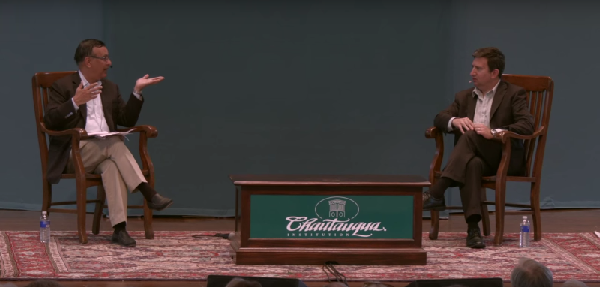
[ by Charles Cameron — Ambassador Husain Haqqani and Daveed Gartenstein-Ross at Chautauqua ]
.
**
From the outset, when cheers went up for Daveed’s birthplace, Ashland, Oregon, and Ambassador Haqqani’s, Karachi — and for the brilliant meeting of the minds that is Chautauqua — it was clear that we were in the presence of two gracious, witty and informed intelligences, and the seriousness of the conversation between them that followed did nothing to reduce our pleasure in the event. Daveed called it “easily the best experience I have ever had as a speaker.”
I’ll highlight some quotes from each speaker, with the occasional comment:
**
Amb. Haqqani:
None of the countries except Egypt, Turkey and Iran, none of the countries of the Middle East are in borders that are historic, or that have evolved through a historic process. And that’s why you see the borders a straight lines. Straight lines are always drawn by cartographers or politicians, the real maps in history are always convoluted because of some historic factor or the other, or some river or some mountains.
And now that whole structure, the contrived structure, is coming apart.
Then most important part of it is, that this crisis of identity – who are we? are we Muslims trying to recreate the past under the principles of the caliphate .. or are we Arabs, trying to unify everybody based on one language, or are we these states that are contrived, or are we our ethnic group, or are we our tribe, or are we our sect? And this is not only in the region, it’s also overlapping into the Muslim communities in the diaspora..
**
If Amb. Haqqani emphasized the multiple identities in play in the Arabic, Islamic, Sunni, Shia, Sufi, and tribal worlds in his opening, Daveed’s emphasis was on the failure of the post-Westphalian concept of the nation state.
Daveed G-R:
In the economic sphere there’s this thing that is often called “legacy industries” – industries that fit for another time, but are kind of out of place today. Think of Blockbuster Video, once a massive, massive corporation.. that’s a legacy industry. So when Ambassador Haqqani talks about how it’s not just in the Middle East that we have this crisis of identity, I think the broader trend is that the Westphalian state that he spoke about, the kind of state that was encoded after the Peace of Westphalia, looks to a lot of people who are in this generation of the internet where ideas flow freely, it looks like a legacy industry.
Why do you need this as a form of political organizing? And what ISIS has shown is that a violent non-state actor, even a jihadist group that is genocidal and implements as brutal a form of Islamic law as you could possibly see, it can hold territory the size of Great Britain, and it can withstand the advance of a coalition that includes the world’s most powerful countries including the United States. And what that suggests is that alternative forms of political organization can now compete with the nation state.
**
The Ambassador then turned to the lessons we should take from 1919’s US King–Crane Commission, reporting on the break-up of the Ottoman Empire — they concluded that it gave us
a great opportunity — not likely to return — to build .. a Near East State on the modern basis of full religious liberty, deliberately including various religious faiths, and especially guarding the rights of minorities
— down to our own times.
Amb. Haqqani:
What we can be sure of is that the current situation is something that will not be dealt with without understanding the texture of these societies. So for example, when the United States went into Iraq without full understanding of its sectarian and tribal composition, and assumed that, all we are doing is deposing a dictator, Saddam Hussein, and then we will hold elections and now a nice new guy will get elected, and things will be all right -– that that is certainly not the recipe. So what we can say with certainty in 2015 is .. over the last century what we have learnt is: outsiders, based on their interests, determining borders is not a good idea, and should certainly not be repeated. Assuming that others are anxious to embrace your culture in totality is also an unrealistic idea.
The sentence that follows was a stunner from the Ambassador, gently delivered — a single sentence that could just as easily have been the title for this post as the remark by Daveed with which I have in fact titled it:
Let me just say that, look, he ideological battle, in the Muslim world, will have to be fought by the likes of me.
Spot on — and we are fortunate the Ambassador and his like are among us.
**
Daveed then turned to another topic I have freqently emphasized myself.
Daveed G-R:
The power of ideas – we as Americans tend not to recognize this when it falls outside of ideas that are familiar to us. So one thing that the US has been slow to acknowledge is the role of the ideology that our friend and ally Saudi Arabia has been promulgating globally, in fomenting jihadist organizations.
And one of the reasons we have been slow to recognize that. I mean one reason is obvious, which is oil. .. But another reason has been – we tend to think of ideas that are rooted in religion – as a very post-Christian country – we tend to think of them as not being real – as ideas which express an ideology which is alien to us –as basically being a pretext, with some underlying motivation which is more familiar to us. That it must be economics, or it must be political anger. I’m not saying those are irrelevant, they’re not – but when Al-Qaida or ISIS explains themselves, taking their explanation seriously and understanding where they’re coming from – not as representatives of Islam as a whole, but as representatives of the particular ideology that they claim to stand for – we need to take that seriously. Because they certainly do.
**
Amb. Haqqani:
The world is not a problem for Americans to solve, it’s a situation for them to understand.
Life is not a problem to be solved but a mystery to be lived.
**
Toward the end of the discussion, Daveed touched on some ideas of recurrent interest to Zenpundit readers..
Daveed G-R:
Looking at the US Government, questions that I ask a lot are: Why are we so bad at strategy? Why are we so bad at analysis? Why do we take such a short term view and negate the long term?
He then freturned to the issue of legacy industries and nation-states:
Blockbuster is a legacy industry. And the reason why legacy industries have so much trouble competing against start-up firms, is because start-ups are smaller, it’s more easy for them to change course, to implement innovative policies, to make resolute decisions – they can out-manoeuver larger companies. And so larger companies that do well adapt themselves to this new environment where they have start-up competitors. Nation-state governments are legacy industries. Violent non-state actors are start-up compoetitors.
— and had the final, pointed word:
We’re a legacy industry ina world of start-up competitors.
**
Having offered you these tastes, at this point I can only encourage you to watch the whole hour and a quarter, filled to the brim with incisive and articulately-stated insights:
In his essay for Powerline, Codevilla turns his attention to the political phenomenon of the improbable GOP presidential front runner, billionaire and reality TV star, DonaldTrump. Unsurprisingly, Dr. Codevilla is not a huge fan of the bombastic Mr. Trump, but his analysis of why Trump has captured the moment so easily has some astute insights about the decaying state of our political system and the seething anger of the electorate:
“In the land of the blind,” so goes the saying, “the one-eyed man is king.” Donald Trump leapt atop other contenders for the Republican presidential nomination when he acted on the primordial fact in American public life today, from which most of the others hide their eyes, namely: most Americans distrust, fear, are sick and tired of, the elected, appointed, and bureaucratic officials who rule over us, as well as their cronies in the corporate, media, and academic world. Trump’s attraction lies less in his words’ grace or even precision than in the extent to which Americans are searching for someone, anyone, to lead against this ruling class, that is making America less prosperous, less free, and more dangerous.
Trump’s rise reminds this class’s members that they sit atop a rumbling volcano of rejection. Republicans and Democrats hope to exorcise its explosion by telling the public that Trump’s remarks on immigration and on the character of fellow member John McCain (without bothering to try showing that he errs on substance), place him outside the boundaries of their polite society. Thus do they throw Br’er Rabbit into the proverbial briar patch. Now what? The continued rise in Trump’s poll numbers reminds all that Ross Perot – in an era that was far more tolerant of the Establishment than is ours – outdistanced both Bush 41 and Bill Clinton before self-destructing, just by speaking ill of both parties before he self destructed
Trump’s barest hints about what he opposes (never mind proposes) regarding just a few items on the public agenda have had such effect because they accord with what the public has already concluded about them. For example,Trump remarked, off the cuff, that “Mexico does not send us its best.” The public had long since decided that our ruling class’s handling of immigration (not just from Mexico) has done us harm. The ruling class – officials, corporations, etc.- booed with generalities but did not try to argue that they had improved America by their handling of immigration. The more they would argue that, the more they would lose. At least if someone more able than Trump were leading against them.
….The point here is simple: our ruling class has succeeded in ruling not by reason or persuasion, never mind integrity, but by occupying society’s commanding heights, by imposing itself and its ever-changing appetites on the rest of us. It has coopted or intimidated potential opponents by denying the legitimacy of opposition. Donald Trump, haplessness and clownishness notwithstanding, has shown how easily this regime may be threatened just by refusing to be intimidated.
Despite this track record of utter failure and brazen venality, our elite have managed to remain firmly in the saddle. Why is this ? In a normal countries they typically have revolutions and coups over far less, but our leaders of both parties managed to cruise from disasters to debacles to win re-election, often by substantial margins.
One reason may be is that the elite, broadly speaking, have managed to restore a substantial degree of control over the information the general public consumes that they had brieflylost inthe early 2000’s and subsequently narrowed and shape the terms of “acceptable” political debate in American society more than ever before.
Once upon a time, the mass media ecology was relatively simple and politically reflected what historian Arthur Schlesinger, Jr. termed “the vitalcenter” of Cold War liberalism. The New York Times editorial page set the general line for informed opinion and most regional and local papers dutifully fell in line, with the Washington Post, TIME, Newsweek, LIFEand US News & World Report generally critiquing whatever debate the Times had begun in greater depth. The three networks ABC, NBC and CBS by contrast simplified and reinforced these narratives with the immediacy and power of television. The “Fairness Doctrine” effectively made the system an elite monopoly by freezing out dissenting opinions from the Left or Right from radio or television broadcast. Cold War liberalism was de facto defined as a politically neutral position not requiring “equal time”. It also represented shared values between most journalists and editors and the American leaders upon whom they reported.
This center began to lose its vitality when liberalism itself became divided over the Vietnam War between hawks and doves and support for various counterculture and cultural liberation movements; the media landscape began to shift and diversify after the Reagan administration terminated the fairness doctrine and the rise of cable news and talk radio. The era of wailing by the gatekeepers really commenced though with the rise of the blogosphere and the early days of social media which contributed to and coincided with the implosionof the newspaperpublishing industry as ad revenue tanked. For a while, the internet meant that the elite lostcontrolof the conversation, carefully constructed media scams were outed, scandals were discovered and online tsunamis of anger came down on the once high and mighty.
Elite control over discourse has been reestablished to a degree, not as a monopoly but as a loose hegemony based on the principles of Co-option, Coordination and Coercion.
And the list of proscribed beliefs and topics grows increasingly long. The following is a partial list of topics or views generally not supposed to be mentioned by candidates, much less debated by the national standards of American politics and mainstream media:
To do well in the first Republican debate, Donald Trump need only show up and select a few of the more emotionally charged themes and throw them like bombs at the other GOP hopefuls on live television who will scatter but be unable to escape the collateral damage. Trump won’t need a plan or a policy or even a reasoned argument because his opponents have no way to talk sensibly about touchy subjects on the minds of millions of voters that their financial backers and the media don’t want them to even acknowledge. Harder still if Trump is getting laugh lines in at their expense. All of Trump’s vainglorious posturing like a professional wrestling heel aside, the man is absolutely at home in the television medium and comfortable in his own skin (to say nothing of his hair).
A real quandary. Attacking Trump personally, calling him names, ganging up on him or echoing liberal media criticisms will only boost his poll numbers with the GOP base and energize his clown car crash of a presidential campaign to new heights. Having nothing to lose himself with his self-parodying run, no need of campaign donors, Trump cannot be controlled and in a live format could drag down any other candidate with him. Or the Republican Party.
Trump would be an absolutely terrible president – its not even clear that he is serious about wanting the job – but as a candidate he is a walking, talking, club for Joe Sixpack to bludgeon an overweening, corrupt and increasingly authoritarian bipartisan elite.
The beating though is richly deserved and long overdue.
[ by Charles Cameron — the election itself a one day affair, and may even be settled by the time you read this — but the impact lingers, and the complex balancing of forces in the region remains ]
.
**
Nothing is ever black-and-white, it seems to me — but there are moment of exceptional clarity, and with the Israeli election (as best I can tell from afar) still in the balance as I write this, two quotes from Herzog (upper panel, below) and Netanyahu (lower panel) strike me as encapsulating the koan facing the Israeli people:
**
Still in the balance.
I was discussing the Middle East earlier in the day, an the issue of balance came up. Cheryl Rofer had said, “The big issue with KSA and Israel is balance of power” and I commented that if you throw Iran into the mix, the issue becomes one of a “balance of balances of power” — which could then be extended on out to include other interested parties.
This brought me to the idea of Alexander Calder mobiles, and the sense that they offer a kinetic equivalent to the static formalism of my own HipBone Games — their precarious balances and homeostases representing by analogy the tensions and resolutions between stakeholders and / or ideas, ideologies, approaches, in a way that features both “equilibrium and its discontents”. Fascinating.
Zenpundit is a blog dedicated to exploring the intersections of foreign policy, history, military theory, national security,strategic thinking, futurism, cognition and a number of other esoteric pursuits.