zenpundit.com » culture

Archive for the ‘culture’ Category

Military Reform through Education

Tuesday, October 20th, 2015

[by Mark Safranski, a.k.a. “zen“]
Photo of Don Vandergriff instructing with a map

Don Vandergriff facilitating Adaptive Soldier/Leader exercises at Fort Benning

Fred Leland at LESC Blog recently had a guest post up by Dan Grazier from the Project on Government Oversight regarding the important work Don Vandergriff is doing to reform professional military education and training:

Military Reform Through Education: From The Straus Military Reform Project, Something We In Policing Can Learn From

….I had the privilege of experiencing this process with a group of 30 soldiers and Department of Defense (DoD) civilians learning about adaptive leadership and mission command. All were teachers from various courses at Fort Benning sent by their senior leaders seeking to infuse new ideas into their organizations. They spent a week learning how to incorporate adaptability into their courses during a seminar taught by CDI military advisor Don Vandergriff and his colleagues with Yorktown Systems Group.

The Adaptive Soldier/Leader Training & Education (ASLTE) seminar aims to move the Army away from outdated assembly-line training methods that teach soldiers to mindlessly execute checklists. Instead, the seminar shows soldiers how to incorporate creative and interactive methods that challenge both students and teachers. This results in empowered soldiers at all levels able to adapt to any situation. [….]

….Don Vandergriff, a retired Army major, has been on the front lines of personnel reform for many years. While he is most noted for his work at the service level, these seminars seek to transform the Army from the bottom up.

Approximately 20 soldiers and 10 civilian educators spent the week learning various teaching methods through experiential learning, which flips the traditional method military students are used to. Most training today follows the “crawl, walk, run” theory all service members are familiar with. Students are generally expected to complete reading assignments, sit through a PowerPoint lecture, and then finally conduct field training to reinforce what they have learned.

The seminar exposed students to new methods by putting the practical exercises first. For example, the seminar uses several Tactical Decision Games (TDGs) to encourage students to rapidly develop a plan for a military problem presented by the facilitators. TDGs can be created for nearly any kind of a situation, but this course mostly used actual battlefield problems like how to capture a bridge or defeat an enemy force entrenched on a hilltop. While working through these problems, the students are exposed to such concepts as Mission Command and the Observe, Orient, Decide, and Act decision cycle, commonly called the OODA Loop or Boyd Cycle.
It is only after the practical exercises that they receive reading assignments about those concepts. Because they’ve encountered them during the exercises, the concepts become more tangible. The OODA Loop, for instance, explains an individual’s or an organization’s decision-making process. It is a difficult concept to truly understand, but it becomes easier when one first sees how it works and then reads about it. The idea is to give them a moment of discovery, that “Ah ha!” moment. Success using such methods is to have a student say, “So, that’s what you call that,” while reading.

Don is making use of several powerful learning methodologies in his Adaptive Leadership philosophy – and I saying “learning” and not “teaching” because Don has properly put the emphasis on the student actively thinking and doing rather than on passively listening to a lecture or discussion. Lecture has a place in education, to explain or to set the student up for new learning experiences, but it should be used sparingly and in short bursts of time when the instructor has carefully set up a “teachable moment”. By having the students doing active problem solving first, they come to Vandergriff armed with their own questions, eager to have feedback.

The use of games are also a very powerful learning tool, perhaps one of the most effective because the situational learning. tends to be transferrable rather than be compartmentalized and isolated information. The right kind of decision games are serious practice for life. This was noted by RAND social scientists way back during the early days of the Cold War:

“The gamers argued that insights arose from immersion in play. In 1956 Joseph Goldstein noted that the war game demonstrated ‘ the organic nature of complex relationships’ that daily transactions obscured.War-gaming gripped its participants, whipping up the convulsions of diplomacy ‘ more forcefully…than could be experienced through lectures or books’.”

” A team from the Social Science Division [ at RAND ] posed a number of questions which they hoped the unfoldig month of gaming would resolve. Chief among them was whether gaming could be used as a forecasting technique ‘ for sharpening our estimates of the probable consequences of policies pursued by various governments’. Would gaming spark “political inventiveness“, and more importantly, how did it compare to conventional policy analysis? Did gaming uncover problems that might otherwise be neglected? And invoking the emerging touchstone of intuition, did the experience impart to policy analysts and researchers “ a heightened sensitivity to problems of political strategy and policy consequences?”

  Sharon Ghamari- Tabrizi, The Worlds of Herman Kahn

Back to the article:

….Vandergriff’s teaching method incorporates recent research into adult learning, designed “to engage students in direct experiences which are tied to real world problems and situations in which the instructor facilitates rather than directs student progress.” This creates a situation where the students learn from one another. Unlike most other military classes, the ASLTE teachers use very few PowerPoint presentations. They also end up speaking far less than the students themselves.

Vandergriff ran the class through the first TDG and led the discussion afterward. From that point forward, students took turns leading the class through After Action Reviews. Students gained confidence in leading such an exercise while the rest of the class bounced ideas off each other. The interactive nature of this kept the entire class engaged and gave all of them ownership of their own learning.

The concept of ownership was a consistent theme throughout the seminar. According to Vandergriff, a good teacher “works to make his students better than himself and encourages them to take ownership of their development, to make them life-long learners.”

Here Don is making use of the social pressure and reinforcement of a Peer to Peer (P2P) dynamic to maintain maximum student engagement while having them practice critical intellectual reflection, something that is a vital constituent of a professional culture of learning. A true professional embraces an honest discussion of ideas and both accepts and gives critical feedback on performance in hopes of learning and improving.

Read more regarding Don Vandergriff’s adaptive leadership methods here and here.

Sunday surprise: House of Cards meets monks and sexy riot grrls

Sunday, October 11th, 2015

[ by Charles Cameron — wondering if the same mind (Beau Willimon?) suggested both? ]
.

Two very different modes of factual reality found their ways into the fictional world of House of Cards, Season 3, American version, and I found the two choices pretty interesting. I’ve recently found clips relating to both on YouTube, so here they are for your consideration:

Pussy Riot:

and

Tibetan monks:

Taking those two choices together is a bit like juxtaposing Gregorian chant and punk rock — which, come to think of it, is pretty close to what I was getting at in my first ever Riot Grrls post, Pussy Riot, Holy Foolishness and Monk Punk.

**

Contemplation and activism — poles apart, or one the mainspring for the other?

ISIS: Paganism with an Islamic Face?

Wednesday, October 7th, 2015

[by Mark Safranski, a.k.a “zen“]

“And thou shalt not let any of thy seed pass through the fire to Moloch, neither shalt thou profane the name of thy God: I am the LORD.”

– Leviticus 18:21 

“They rejected the commandments of the Lord … and served Baal. They consigned their sons and daughters to the fire”

– 2 Kings 17:16–17

“And do not kill your children for fear of poverty. We provide for them and for you. Indeed, their killing is ever a great sin”

  – Qur’an 17:31

In a recent comment section conversation with Charles Cameron and RAND scholar David Ronfeldt on the character of Fascism and its resurgence, I remarked that ISIS adopting a Fascist style in its propaganda and governance may be drawing upon a ghastly and ancient lineage:

ISIS is really embracing Fascism. It’s ceremonial public executions actually supercede what the Nazis and Fascists did only symbolically with blood flags and heroic cenotaphs and so on. It is reaching back to something very dark and protean, human sacrifice, as a political symbol. I think [ Moshe] Halbertal’s book On Sacrifice, is a useful reference here on how deep this goes culturally, to the bronze age or earlier.

ISIS has for some time been making quite a perverse spectacle of its executions of prisoners, combatant and non-combatant alike, releasing videos to international fanfare and glorying in the resultant horror and global infamy. The precedent for this macabre “propaganda of the deed“was initially set by the forefather of ISIS, the Jordanian jailbird upjumped to “terrorist mastermind”, the late Abu Musab al-Zarqawi, who originally led al Qaida in Iraq during the American occupation of Iraq. Prior to expiring after U.S. forces dropped a 500 lb bomb on his head, al-Zarqawi pioneered the use of  beheading videos, usually featuring himself being filmed incompetently and gruesomely sawing off an orange jumpsuit-clad captive’s head with a large knife, blood spraying everywhere.

Zarqawi’s ghoulish innovation in terrorist messaging admittedly held a certain fascination for the psychopathic segment of Sunni Islamist extremists and it attracted foreign fighters of this nature to Iraq who in turn lionized Zarqawi as “the Sheikh of Slaughterers”; but the beheading videos also generally horrified public opinion in the Muslim world and repelled even hardened jihadis, earning Zarqawi a rebuke from al Qaida number two, Ayman al-Zawahiri:

….Among the things which the feelings of the Muslim populace who love and support you will never find palatable – also- are the scenes of slaughtering the hostages. You shouldn’t be deceived by the praise of some of the zealous young men and their description of you as the shaykh of the slaughterers, etc. They do not express the general view of the admirer and the supporter of the resistance in Iraq, and of you in particular by the favor and blessing of God.

….However, despite all of this, I say to you: that we are in a battle, and that more than half of this battle is taking place in the battlefield of the media. And that we are in a media battle in a race for the hearts and minds of our Umma. And that however far our capabilities reach, they will never be equal to one thousandth of the capabilities of the kingdom of Satan that is waging war on us. And we can kill the captives by bullet. That would achieve that which is sought after without exposing ourselves to the questions and answering to doubts. We don’t need this. 

Zarqawi’s Iraqi bloodlust ended only because it was interrupted by the American military, but the leaders of ISIS have carried on. Far from accepting Zawahiri’s advice, they have doubled down, greatly upgrading the marketing of ritualistic murder from Zarqawi’s crude snuff films to slick videos with professional editing and high production values that have become central to the online “brand” of the ISIS “caliphate”. Like the hosts of a sinister game show, ISIS spokesmen have found the time to murder creatively in order to keep their audience of Islamist terrorist wannabes in the West tuned in and captivate the attention of the global media (though sometimes, things do not work  out as planned).


However effective this circus of horrors has been at daunting their enemies and attracting the allegiance of “zealous young men” to ISIS, it reveals an atavistic impulse at play that no amount of Quranic hand-waving can paper over and conceal. Jurisprudence is absent here; not even the grim and rough Islamic “justice” of the Taliban is given to prisoners of ISIS, which violates the customary protections given under Islamic law or historical Muslim judicial practices. These choreographed and sensationalized executions by ISIS are really a cryptic revival of the ancient and terrible practice of human sacrifice, that in most cultures and religions had long been replaced by symbolic ritual, but once reigned supreme during the Bronze Age, not least in ancient Iraq, which if new findings are to be believed was like Aztec Mexico, a charnel-house of slaughter.

Originating in the Stone Age, human sacrifice in the religious sense of an offering to the gods or God, lasted a surprisingly long time. Setting aside the preColumbian cultures of the New World, the ancient Romans, for example, did not formally outlaw human sacrifice until the first century BC, though the practice had become archaic and Rome vigorously sought to stamp it out among the Gauls and Britons, among whom human sacrifice was an accepted part of Druidic religion. Nor was human sacifice entirely unknown among the ancient Greeks of the classical period while child sacrifice was probably central to Carthaginian state rites to such a degree that other peoples of the time, including the Romans, found abhorrent.

What occurred in many cases is that as civilizations evolved in social complexity, substitutionary practices for human sacrifice developed that served the same impulse, to propitiate and honor their God(s) and create powerful emotional bonds among the participants:  animal sacrifice, burial ceremoniesmysteries, religious ritual, necromancy, symbolism in theater and political matters of state religion. The Biblical tale of Abraham and Isaac is itself a scriptural admonition to the ancient Hebrews to adopt animal sacrifice as most pleasing to God, a practice the Israelites and Jews of the classical period continued until the destruction of the second temple by the Roman general Titus. From that point on, from the close of the first century AD, Jews and the early, still Judaic, Christians moved away from the practice of animal sacrifice and substituted prayer and theology of salvation, respectively. Sacrifice, especially human sacrifice, became a distinguishing mark of paganism and the subject of Christian crusades in the middle-ages, like the brutal war waged by the Teutonic Knights against the human sacrificing Old Prussians and Lithuanian barbarian tribes.

The Binding of Isaac

The end of late medieval European religious warfare and the rise of the Westphalian system after the Thirty Year’s War slowly shifted the symbolic moral center of sacrifice from God to the State, with divine right monarchy serving as a waystation for the incubation of modern nationalism. There was an epistemic shift, as Halbertal argues in On Sacrifice from a sacred and mystical “sacrificing to” the sovereign God borrowed from the examples of Jewish martyrdom by early Christians who shared in the Romans the same persecutors. This shift opened the gates of permissible sacrifices, legitimating a new secular and political “sacrificing for” the glory of the State.

It is a profound difference but occurring within the same phenomena, as illustrated by two quotes:

…And it came to pass after these things, that God did tempt Abraham, and said unto him, Abraham: and he said, Behold, here I am.

And the Lord said, Take now thy son, thine only son Isaac, whom thou lovest, and get thee into the land of Moriah; and offer him there for a burnt offering upon one of the mountains which I will tell thee of.

                                                                              – Genesis 22:2

And:

….But, in a larger sense, we can not dedicate – we can not consecrate – we can not hallow, this ground – The brave men, living and dead, who struggled here, have hallowed it, far above our poor power to add or detract. The world will little note, nor long remember what we say here; while it can never forget what they did here.

It is rather for us, the living, we here be dedicated to the great task remaining before us – that, from these honored dead we take increased devotion to that cause for which they here, gave the last full measure of devotion – that we here highly resolve these dead shall not have died in vain; that the nation, shall have a new birth of freedom, and that government of the people, by the people, for the people, shall not perish from the earth.

     – Abraham Lincoln

Gettysburg and Antietam were not Mount Moriah. Neither were the Somme or Stalingrad the same as the Tophet. From time of the Patriarch Abraham to the presidency of Abraham Lincoln, nations of men ceased to sacrifice usually helpless others but moved to sacrifice themselves in what they reckoned as the highest cause. Movement away from human sacrifice as practiced by ancient Carthaginian or animal sacrifice as practiced by most peoples of antiquity, including the Jews, to gentler substitutionary practices, Moshe Halbertal has called the “cataclysmic shift” in the history of civilization.

If so, it is a shift that ISIS has begun to reverse.

In their outstanding ISIS: The State of Terror, counterterrorism scholars Jessica Stern and J.M. Berger analyze the dark obsession ISIS has demonstrated in its propaganda messaging with exquisitely orchestrated executions:

….As we have noted, ISIS’s psychological warfare is directed at its potential victims. But it is also directed at those it aims to control. It is deliberately attempting to blunt its follower’s empathy by forcing them to participate in or observe acts of brutality. Over time, this can lead to secondary psychopathy, or a desire to harm others, and contagion of violence. Beheadings are one such tool for blunting empathy.

Berger and Stern are likely correct that the methodical character of ISIS demonstrations of brutality are intended to desensitize the participants and (as they further explained) a tendency to cultivate secondary psychopathology in ISIS recruits, especially the young. A similar process occurred during the Holocaust with Nazi Einsatzgruppen and reserve unit police battalions detailed to assist the SS mobile killing squads on the Eastern front. Many serving in these units, already fanatical National Socialists, became inured to the suffering of women, children and the old who were shot and dumped still alive into mass graves, though some SS men showed signs of PTSD, depression and higher rates of severe alcoholism, desertion and suicide.

The comparison between the genocidal cruelty of the SS and ISIS, while natural, is limited by a very important distinction. However zealous their ideological fanaticism and dedicated in their murderous mission to exterminate European Jewry, the SS lacked the context of moral certainty and the psychological reinforcement effects of religious exaltation enjoyed by ISIS killers. Even the malevolent Heinrich Himmler, in his secret speech to Nazi gauleiters and SS leaders, regarded the Final Solution as a terrible burden that the SS shouldered on behalf of the Fuhrer to assure Germany’s future; a “glorious” crime that Himmler believed must be kept forever hidden from history and the German people.

Not so ISIS, which revels in its bloody terror. Worse, the repetition of garish executions as public celebrations by ISIS, with a vague but constant religious context, devoid of any shred of Islamic legality, inevitably acquire over time the theological characteristics of Halbertal’s “sacrificing to”  – what began as harsh jihadi jurisprudence and psychological warfare mutated under conditions of lazy, sociopathic brutality and totemic invocations of Islam into ritual “offering” by ISIS of its prisoners of war as human sacrifices in the manner of the ancient pagans. A perverse blasphemy, but one that draws on a powerful archetype deeply buried in the human psyche.

ISIS leaders have not only looked into the Abyss, they have descended into and become one with it.

Lexington Green Interviewed on Against the Current

Thursday, September 10th, 2015

[by Mark Safranski, a.k.a. “zen“]

America 3.0 : Rebooting Prosperity in the 21st Century by James C. Bennett and Michael Lotus

Lexington Green” of Chicago Boyz blog, a.k.a Michael Lotus, co-author of America 3.0 was interviewed recently by Chicago talk radio host and TV commentator Dan   Proft, on Proft’s video podcast, Against the Current.

I heartily approve of the cigars.

Tune in for approximately fifty minutes of conversation regarding national and local politics, futurism, economics and political philosophy through the analytic prism of America 3.0 (a book I warmly endorse):


We’re a legacy industry in a world of start-up competitors

Wednesday, August 26th, 2015

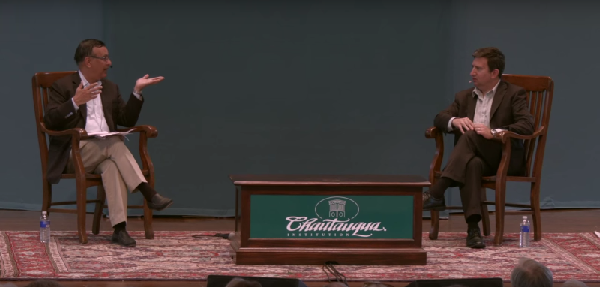
[ by Charles Cameron — Ambassador Husain Haqqani and Daveed Gartenstein-Ross at Chautauqua ]
.

chautauqua haqqani daveed

**

From the outset, when cheers went up for Daveed’s birthplace, Ashland, Oregon, and Ambassador Haqqani’s, Karachi — and for the brilliant meeting of the minds that is Chautauqua — it was clear that we were in the presence of two gracious, witty and informed intelligences, and the seriousness of the conversation between them that followed did nothing to reduce our pleasure in the event. Daveed called it “easily the best experience I have ever had as a speaker.”

I’ll highlight some quotes from each speaker, with the occasional comment:
**

Amb. Haqqani:

None of the countries except Egypt, Turkey and Iran, none of the countries of the Middle East are in borders that are historic, or that have evolved through a historic process. And that’s why you see the borders a straight lines. Straight lines are always drawn by cartographers or politicians, the real maps in history are always convoluted because of some historic factor or the other, or some river or some mountains.

You’ll see how neatly this fits with my recent post on borders, No man’s land, one man’s real estate, everyone’s dream?

And now that whole structure, the contrived structure, is coming apart.

Then most important part of it is, that this crisis of identity – who are we? are we Muslims trying to recreate the past under the principles of the caliphate .. or are we Arabs, trying to unify everybody based on one language, or are we these states that are contrived, or are we our ethnic group, or are we our tribe, or are we our sect? And this is not only in the region, it’s also overlapping into the Muslim communities in the diaspora..

**

If Amb. Haqqani emphasized the multiple identities in play in the Arabic, Islamic, Sunni, Shia, Sufi, and tribal worlds in his opening, Daveed’s emphasis was on the failure of the post-Westphalian concept of the nation state.

Daveed G-R:

In the economic sphere there’s this thing that is often called “legacy industries” – industries that fit for another time, but are kind of out of place today. Think of Blockbuster Video, once a massive, massive corporation.. that’s a legacy industry. So when Ambassador Haqqani talks about how it’s not just in the Middle East that we have this crisis of identity, I think the broader trend is that the Westphalian state that he spoke about, the kind of state that was encoded after the Peace of Westphalia, looks to a lot of people who are in this generation of the internet where ideas flow freely, it looks like a legacy industry.

Why do you need this as a form of political organizing? And what ISIS has shown is that a violent non-state actor, even a jihadist group that is genocidal and implements as brutal a form of Islamic law as you could possibly see, it can hold territory the size of Great Britain, and it can withstand the advance of a coalition that includes the world’s most powerful countries including the United States. And what that suggests is that alternative forms of political organization can now compete with the nation state.

**

The Ambassador then turned to the lessons we should take from 1919’s US King–Crane Commission, reporting on the break-up of the Ottoman Empire — they concluded that it gave us

a great opportunity — not likely to return — to build .. a Near East State on the modern basis of full religious liberty, deliberately including various religious faiths, and especially guarding the rights of minorities

— down to our own times.

Amb. Haqqani:

What we can be sure of is that the current situation is something that will not be dealt with without understanding the texture of these societies. So for example, when the United States went into Iraq without full understanding of its sectarian and tribal composition, and assumed that, all we are doing is deposing a dictator, Saddam Hussein, and then we will hold elections and now a nice new guy will get elected, and things will be all right -– that that is certainly not the recipe. So what we can say with certainty in 2015 is .. over the last century what we have learnt is: outsiders, based on their interests, determining borders is not a good idea, and should certainly not be repeated. Assuming that others are anxious to embrace your culture in totality is also an unrealistic idea.

The sentence that follows was a stunner from the Ambassador, gently delivered — a single sentence that could just as easily have been the title for this post as the remark by Daveed with which I have in fact titled it:

Let me just say that, look, he ideological battle, in the Muslim world, will have to be fought by the likes of me.

Spot on — and we are fortunate the Ambassador and his like are among us.

**

Daveed then turned to another topic I have freqently emphasized myself.

Daveed G-R:

The power of ideas – we as Americans tend not to recognize this when it falls outside of ideas that are familiar to us. So one thing that the US has been slow to acknowledge is the role of the ideology that our friend and ally Saudi Arabia has been promulgating globally, in fomenting jihadist organizations.

And one of the reasons we have been slow to recognize that. I mean one reason is obvious, which is oil. .. But another reason has been – we tend to think of ideas that are rooted in religion – as a very post-Christian country – we tend to think of them as not being real – as ideas which express an ideology which is alien to us –as basically being a pretext, with some underlying motivation which is more familiar to us. That it must be economics, or it must be political anger. I’m not saying those are irrelevant, they’re not – but when Al-Qaida or ISIS explains themselves, taking their explanation seriously and understanding where they’re coming from – not as representatives of Islam as a whole, but as representatives of the particular ideology that they claim to stand for – we need to take that seriously. Because they certainly do.

**

Amb. Haqqani:

The world is not a problem for Americans to solve, it’s a situation for them to understand.

This makes a nice DoubleQuote with Gabriel Marcel‘s more general aphorism:

Life is not a problem to be solved but a mystery to be lived.

**

Toward the end of the discussion, Daveed touched on some ideas of recurrent interest to Zenpundit readers..

Daveed G-R:

Looking at the US Government, questions that I ask a lot are: Why are we so bad at strategy? Why are we so bad at analysis? Why do we take such a short term view and negate the long term?

He then freturned to the issue of legacy industries and nation-states:

Blockbuster is a legacy industry. And the reason why legacy industries have so much trouble competing against start-up firms, is because start-ups are smaller, it’s more easy for them to change course, to implement innovative policies, to make resolute decisions – they can out-manoeuver larger companies. And so larger companies that do well adapt themselves to this new environment where they have start-up competitors. Nation-state governments are legacy industries. Violent non-state actors are start-up compoetitors.

— and had the final, pointed word:

We’re a legacy industry ina world of start-up competitors.

**

Having offered you these tastes, at this point I can only encourage you to watch the whole hour and a quarter, filled to the brim with incisive and articulately-stated insights:


Switch to our mobile site